“Ulysses” by Alfred Lord Tennyson: A Reader-Response Commentary
There are some poems I’ve studied that are so touching so inspiring that I have never forgotten my first encounter. “Ulysses” by Alfred Lord Tennyson is one of those. Since I am a believer in the Reader Response theory of literary study, I decided to revisit this poem that deeply affected me many years ago when I was in college and see how my personal response to that poem may have shifted or changed. I don’t have those early notes, but I vividly remember how the poem affected me. Reader response can include religious, cultural news and facts, family, personal successes and failures, lessons learned, etc. Many preachers use a reader response when speaking from the Bible. There are some preliminary facts about the poem that should be kept in mind before a line-by-line commentary is attempted.
First, Tennyson wrote the poem in 1833 after the death of his friend, Arthur Henry Hallam a poet, and the subject of Tennyson’s poem In Memoriam. The poem was first published in 1842. Hallum is known as the jeune homme fatal, the doomed young man of his generation. In form, it is an interior dramatic monologue, written in blank verse (unrhymed Iambic pentameter). Now, here is the text and my commentary in italics. I may add more thoughts later, so it may be a work in progress:
It little profits that an idle king,
By this still hearth, among these barren crags,
Match’d with an aged wife, I mete and dole
Unequal laws unto a savage race,
That hoard, and sleep, and feed, and know not me.
I also feel listless at times. As a college instructor, I’ve always felt my task was to civilize my students. More and more students enter my courses as savages—rude, unread, lazy (I believe in rigorous academics), dishonest (plagiarism is too common), lacking patriotism, with a victim mentality, and too easily influenced by popular fads of media and politics.
I cannot rest from travel: I will drink
Life to the lees: All times I have enjoy’d
Greatly, have suffer’d greatly, both with those
That loved me, and alone, on shore, and when
Thro’ scudding drifts the rainy Hyades
Vext the dim sea: I am become a name;
For always roaming with a hungry heart
Much have I seen and known; cities of men
And manners, climates, councils, governments,
Myself not least, but honour’d of them all;
And drunk delight of battle with my peers,
Far on the ringing plains of windy Troy.
I am a part of all that I have met;
I have traveled extensively across the nation since 2007, as a storyteller, musician, and author. Sometimes, I’ve experienced great joy, at other times, suffering, sacrifice and pain. When I reflect on those journeys, cities, events, and people I’ve encountered, I realize how greatly they have affected me. I too am a part of all I’ve met. It’s hard for me to rest from travel. To go from close to 150 presentations across the nation to almost nothing because of the COVID shutdown has been hard.
Yet all experience is an arch wherethro’
Gleams that untravell’d world whose margin fades
For ever and forever when I move.
How dull it is to pause, to make an end,
To rust unburnish’d, not to shine in use!
As tho’ to breathe were life! Life piled on life
Were all too little, and of one to me
Little remains: but every hour is saved
From that eternal silence, something more,
A bringer of new things; and vile it were
For some three suns to store and hoard myself,
And this gray spirit yearning in desire
To follow knowledge like a sinking star,
Beyond the utmost bound of human thought.
The COVID shutdown, not only cost me a great amount of money, but it revealed how my schedule drove me on and how boring my life can be without goals and tasks and opportunities. As another possible shutdown of the nation looms before us, I hope I can keep this same positive attitude to follow knowledge. I don’t want to rust out. I need to use my time better, to “save every hour from that eternal silence.” I still want to see how far I can go.
This is my son, mine own Telemachus,
To whom I leave the sceptre and the isle,—
Well-loved of me, discerning to fulfil
This labour, by slow prudence to make mild
A rugged people, and thro’ soft degrees
Subdue them to the useful and the good.
Most blameless is he, centred in the sphere
Of common duties, decent not to fail
In offices of tenderness, and pay
Meet adoration to my household gods,
When I am gone. He works his work, I mine.
I too have a son, who seems to have more sense than I have, more stability, and so committed to his own work. All I leave behind when I leave this world will be in his hands.
There lies the port; the vessel puffs her sail:
There gloom the dark, broad seas. My mariners,
Souls that have toil’d, and wrought, and thought with me—
That ever with a frolic welcome took
The thunder and the sunshine, and opposed
Free hearts, free foreheads—you and I are old;
Old age hath yet his honour and his toil;
Death closes all: but something ere the end,
Some work of noble note, may yet be done,
Not unbecoming men that strove with Gods.
The lights begin to twinkle from the rocks:
The long day wanes: the slow moon climbs: the deep
Moans round with many voices. Come, my friends,
‘T is not too late to seek a newer world.
Push off, and sitting well in order smite
The sounding furrows; for my purpose holds
To sail beyond the sunset, and the baths
Of all the western stars, until I die.
It may be that the gulfs will wash us down:
It may be we shall touch the Happy Isles,
And see the great Achilles, whom we knew.
Tho’ much is taken, much abides; and tho’
We are not now that strength which in old days
Moved earth and heaven, that which we are, we are;
One equal temper of heroic hearts,
Made weak by time and fate, but strong in will
To strive, to seek, to find, and not to yield.
I hope this will always be my optimistic attitude, my philosophy. I may go down, but I won’t die sitting still, without dreams. I do a song in my music show, “40 Days of Rain,” that has these lines: “This dry land may get me, but it ain’t got me yet.” Like a farmer, I must wait to see what the next year will bring my way. The last two lines are my favorite in this poem. “Made weak by time and fate, but strong in will to strive, to seek, to find, and not to yield.”
 It is said by those who heard the tales from the ancients, the old men and women of Wales, who heard the story first from those who had memories of the Druids and even Arthur’s sword. It is said that on those late summer afternoons when the sun is still shining hot and strong and raindrops fall from the blue sky, fall warm on your skin, it is said that if you sit in a quiet place of rocks and trees and if you shut your eyes, you’ll hear a harp’s melody, soft and sad and sweet as a harper using golden strings.
 Until I picked up this book about the life and writings of Émile Zola, I did not realize how little I knew about French authors. The book is part of the Twayne World of Authors Series and had been discarded from a university library. My reading of the book was slow and deliberate and I marked phrases I liked, had to look up and research French words, historical events, and places–some of which I made marginal notes about.
 My research revealed that there are many websites, detailed books, and fine videos concerning Zola. Elliott M. Grant, the author/editor, spent many years researching Zola. The book is not intended to be an exhaustive biography, but it does include enough to help the reader to understand Zola and appreciate his literary work, which includes novels, short stories, poems, journal and newspaper articles, and dramatic works. The book includes chapter notes and references, a selected bibliography, and an index. My feeling is that the book is an easy reference and useful tool for one wanting to explore Zola and his world.



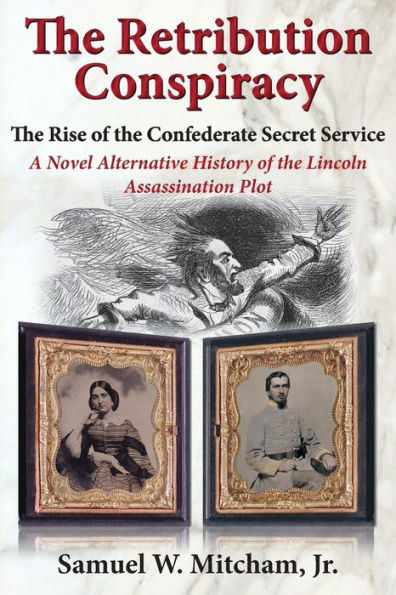 The full title on the novel cover is The Retribution Conspiracy: The Rise of the Confederate Secret Service. Below the cover title, one can read, A Novel Alternative History of the Lincoln Assassination Plot. Though I know a technique of writing historical fiction is to choose a topic, person, or historical incident that will interest people, I thought that this key moment in American history is a well-known topic that the general reading public knows something about. I wondered why he chose this topic. However, when I read this novel by Samuel W. Mitcham, I was truly surprised. I am an avid reader of history, fiction, creative nonfiction, and some historical fiction. I was hooked after reading the author’s introduction. After I completed a reading of this novel, demanded I write a review, something I’ve never done with a historical novel, though I’ve read and always admired Michener’s novels.
 While most Americans currently chafe under the increasing control of the rich, liberal elite political leaders in Washington who promote globalism, create a society of victims totlly dependent on government handouts, and while we are suffering the effects of the Cancel Culture and the WOK mentality that daily thrashes, punishes, and targets any person or business that does not tow the leftist, liberal agenda, I was delighted to discover a strong Nationalistic movement in Brittany. Bretons chafe under the control of the rich Parisian liberals. Bretons consider Brittany their home, their nation, not France. Visitors to Brittany will see the old Celtic flag of Brittany everywhere and in songs and celebrations, one can discover how passionate one’s love for one’s homeland, culture, and history can be.
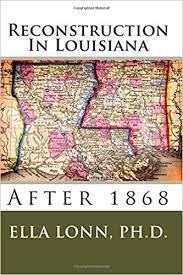 After the War Between the States, students of Louisiana history enter the dark and sad age of Reconstruction. In her fine book, Reconstruction in Louisiana After 1868, Ella Lonn, Ph.D., reveals how the actions and corruption of carpetbaggers (opportunist from the North), scalawags (reconstructed Southerners), military and government officials ruined the state’s economy, elections, and education. The purpose of this blog post is to share one example of how often in Reconstruction appointments and funds for education were misappropriated and funneled into the salaries of pathetically unqualified people in important educational positions. Lonn says this: “School directors were often unable to write their names. A letter (mailed Jan. 9, 1972) from the president of the school board of Carroll Parish, as printed in the National Republican, is so ungrammatical and misspelled that it is almost impossible to read it. Here is the actual letter: