Confronting Bad History by Dr. Samuel Mitchum

NATHAN BEDFORD FORREST vs. BILL O’REILLY:  I’ve read every book Bill O’Relilly has written, and enjoyed and learned from them greatly. The writers he used to co-write his books have generally provided excellent texts, until I read a chapter in his book Confronting Evil,  that had a chapter devoted to Confederate General Nathan Bedford Forrest. This was a disappointment because of the numerous historicak errors. Read his fine essay by Dr. Samuel W. Mitcham and you will see that the popular beliefs about General Forrest are blantantly false.

CONFRONTING BAD HISTORY

By Dr. Samuel W. Mitcham, Jr.

Recently, well-known commentator Bill O’Reilly produced a book, Confronting Evil, which is reportedly selling very well. It contained a great many falsehoods about Confederate Lieutenant General Nathan Bedford Forrest. Walter D. Kennedy, the commander-in-chief of the Sons of Confederate Veterans, honored me by asking if I would write a rebuttal. I had no idea what I was getting myself into. Since O’Reilly is a sanctimonious New Yorker (he suffers from what General Scales called Sanctimonious Delusion Disorder or SDD), I expected some mistakes.[1] I did not expect fifty of them, great and small; an astute and well-informed reader could probably identify a few more.[2]

Of the evil people that O’Reilly mentions, Nathan Bedford Forrest is the subject of Chapter 5. Although he did a fairly good job on some of his earlier books, including Killing Lincoln and Killing Patton, O’Reilly’s chapter on Forrest proves that no work is entirely useless; it can always serve as a bad example to others. A partial list of his mistakes is shown below.

  1. Let’s begin with O’Reilly’s first sentence, “The terrified [Union] soldiers are surrounded.” No, they were not terrified. Actually, they were drunk, or at least a good many of them were. They taunted the Confederate soldiers, dared them to attack, and declared they would take no prisoners if they did. This is not a recommended procedure for troops who are both outnumbered and surrounded.
  2. According to O’Reilly, they are well armed with Springfield rifles, field cannons, and sidearm pistols but are out of ammunition and have not slept for two days. In reality, many of the Federals (especially the African Americans) are poorly armed. They include a badly understrength heavy artillery regiment, which should have eighteen to thirty heavy guns. It had a total of four light field pieces. Many of the men are armed with clubs—a pretty ineffective weapon against veteran Rebel soldiers armed with six-shooters (called “Navy Sixes”).
  3. They [the Yankees] have not slept in two days. No, there is no evidence that they have missed any sleep at all. The first Rebel soldiers arrived at Fort Pillow on April 12, 1861, and Forrest captured the fort the same day.
  4. The Union soldiers are from the Sixth US Artillery Regiment. No, actually, they are from the Sixth Regiment, United States Colored Troops Artillery Regiment, which is sometimes abbreviated as the 6thUSCT Artillery Regiment.[3] “Sixth US Artillery” would indicate it was a Regular Army white unit.
  5. The Union troops are starving. No, actually, they were not. There is no evidence that they ever missed a meal.
  6. The Union soldiers looked down on the Rebels from a one-hundred-foot wall. Wrong again. O’Reilly (or whoever wrote this chapter) is looking the wrong direction. In 1864, at this point, the Mississippi River flowed north to south.[4] The bluff Fort Pillow defended was eighty feet high and faced the river. The wall overlooking the trench was called the Redan. It was eight feet high. The bluff faced west. The wall overlooking the Confederates faced east, the direction from which Forrest and his men came.
  7. Thousands of rats scurry among the corpses. Wrong again. O’Reilly has the Union troops eating rats, who were fat because they feasted on dead bodies. This did not occur.
  8. For the last thirty days, Confederate forces have bombarded Fort Pillow. That is pure fiction. Whoever wrote this had no idea what the true military situation was in west Tennessee at this time. In 1864, no Confederate forces were anywhere near Fort Pillow until early on April 12, when Colonel Black Bob McCullock arrived with his brigade, which was part of Forrest’s cavalry.
  9. “Fort Pillow is a oneacre facility . . .” No, Fort Pillow is a 1,642-acre facility, according to the park service. It was built by Confederate Colonel (later Major General) Patrick Cleburne in 1861. It had three lines of trenches (called rifle pits in those days) and was initially designed for a garrison of 20,000 men. The trenches have been somewhat filled in by erosion in the 160-plus years since the battle, but they are still clearly visible, indicating that O’Reilly or his ghostwriter never bothered to visit Fort Pillow. The Redan, which I suppose O’Reilly refers to, was about one acre in size. It was the Federals’ final defensive position.
  10. O’Reilly discussed the strategic importance of Fort Pillow. It seems to escape his attention that it had no importance after the Confederates lost control of the river when Vicksburg fell in 1863. General Sherman, the overall Union commander of this sector, obviously thought it had no military significance. In January 1864, he ordered it abandoned.
  11. The Union commander in the Memphis sector, Major General Stephen A. Hurlbut, obeyed Sherman’s order to abandon the fort, but he reoccupied it a month later without informing Sherman. Hurlbut was one of the more corrupt Union generals, and he wanted to use it so cotton buyers could secretly transport the product north. To do this, they had to get a permit from General Hurlbut—and that cost them. But the cotton speculators didn’t mind paying a bribe. The price of “White Gold” had increased from $.06 a pound in 1860 to $1.09 in 1864, with spikes as high as $1.90. The value of Fort Pillow to the Yankees was economic, not military. O’Reilly should have investigated this as well, but he did not. This is a mistake of omission, but it is in my opinion still a mistake that a journalist with Mr. O’Reilly’s reputation should not have made.[5] (That ends the list of errors Mr. O’Reilly made on the first page of this chapter, which includes only half a page of text. Now let’s turn to the second page.)
  12. . . . the federal soldiers are outnumbered four to one. However, surrender is not an option. Actually, surrender was an option (as O’Reilly admits on page 88) and the only viable one at that. Twice, General Forrest called upon them to surrender. He hated to waste lives, and he knew he would capture the fort, but he also knew that men would be killed if he were forced to attack. He called upon the Union commander to surrender to prevent the useless effusion of blood, but the Federal would not do so.
  13. “. . . rebels do not usually capture integrated forces. They kill them.” First of all, the garrison at Fort Pillow was integrated, but the forces were not. They consisted of the 6th USCT Artillery Regiment (African Americans), part of the 2nd USCT Artillery Regiment (African American), and the 13thTennessee Cavalry, a Union regiment made up of “Tennessee Tories” or “home-grown Yankees.” Its men were mainly outlaws, renegades, Confederate deserters, rapists, looters, plunderers, and other desperados. It was white. Incidentally, it did not fight as well as the USCTs. Also, when the battle ended, three hundred Yankees (a third of them African Americans) were huddled together with their backs to the Mississippi River.[6] Forrest could have killed them all if he had he wanted to. He just didn’t want to.
  14. O’Reilly is vague about the actual numbers of men inside the fort at various times during the battle. He should have consulted John Cimprich and Robert C. Mainfort, Jr.’s, book, Fort Pillow, which is quite specific vis-à-vis these numbers. It is pretty obvious that he lacks familiarity with the literature on this subject.
  15. One should be familiar with the literature on a particular subject before writing about it. I do not believe Mr. O’Reilly—or whoever wrote this chapter—did this.
  16. O’Reilly has Forrest smoking “Cheroots,” his favorite cigar. No other source I am aware of ever mentioned Bedford Forrest smoking. Thinking I might have missed something, I contacted John R. Scales, a retired brigadier general in the Special Forces and the author of several books, including two on General Forrest and his campaigns. General Scales never misses anything. He told me that he had never heard of Forrest smoking but suggested that O’Reilly might have been thinking of Sherman, who smoked Cheroots. I concluded that, in a short chapter, O’Reilly attributed three vices to Forrest that he did not have—drinking, whoring, and smoking. This suggests that O’Reilly did not understand Nathan Bedford Forrest at all.
  17. The Southern lawmakers, according to O’Reilly, passed a new law in 1864 stating that any black person captured in battle would not be taken prisoner. This is simply not true. They did pass a law providing that captured African Americans would be returned to slavery. The Confederate Congress also passed a law stating that white officers who led black troops were guilty of fermenting servile insurrection and could be summarily executed.
  18. In March 1864, the Rebels launched a campaign to reclaim control of the Mississippi River. No, they did not. O’Reilly writes: “Now on the defensive, the rebels launch a campaign to reclaim control of the Mississippi River.” How does one reclaim the Mississippi while on the defensive? Obviously, recapturing the river requires offensive operations. Mr. O’Reilly has, in my opinion, managed to contradict himself in one sentence.
  19. Now we have reached the top of page 88, the third page of the chapter. The author flips back in time to 1861 and denounces Forrest as a “brutal” slave trader, but he does not elaborate—possibly because he can’t. Actually, Forrest was considered the best of a bad lot in the 1850s. He never beat his slaves, refused to separate families when he sold them, and kept a list of people who actually were brutal slave traders—and he would not do business with them. (Refusing to beat slaves was not altogether altruistic. If a potential buyer saw that a slave had been beaten, it signaled to him that this was a troublesome slave. The last thing a master wanted was an unruly slave, so he would lower the offering price, if he didn’t cancel the sale altogether.) If Forrest bought a slave who was already separated from his family, he tried to purchase them as well to reunite the family. Forrest did have a heart, although if the reader has only this chapter to go by, they probably wouldn’t think so.
  20. Now O’Reilly flips back to April 5, 1864. Forrest receives word from President Davis that he was to lead the final assault on Fort Pillow. No such order was ever issued. Even if Davis wanted to issue the order, Forrest was on his Third West Tennessee raid and was far behind enemy lines. There is no way the president could have contacted Forrest to order him to finish a siege that never took place.
  21. Historic sins of omission are still historic sins. So, what did O’Reilly miss? If Forrest did not respond to an order from President Davis, why did he attack Fort Pillow? The answer can be given in one word: chivalry. I know people suffering from NCDD will bristle at this, but the evidence is pretty straightforward. Forrest was returning from his Third West Tennessee Raid when he halted at Eaton. Here, several ladies begged him to take Fort Pillow. Members of the garrison, they declared, were former slaves who were now terrorizing the families of their former masters, committed several robberies, made a special point of insulting the wives, sisters, widows, and orphans of Confederate soldiers, and vented upon the women “the most opprobrious and obscene epithets.” Some women were even raped. General Forrest, who was always the self-ordained protector of Southern womanhood, immediately descended into a cold rage. “You may go home and rest assured that I will take the fort if it costs me my life,” he snapped. Other delegations of women would relate similar stories to Forrest as he wrapped up his raid, but from the Eaton meeting, Fort Pillow was doomed.
  22. According to the author, Forrest made his fortune selling slaves and harvesting cotton. Actually, that is only part of the story. He was a successful horse trader and a highly successful gambler, but he also made a great deal of money as a land speculator. For a time, he ran a mercantile business, operated a stage line, owned a brickyard, and (post-bellum) owned a railroad. Forrest was an entrepreneur—and yes, that did include slave trading—but it wasn’t limited to slave trading and producing cotton.
  23. Flipping back to 1864, Forrest arrives at Fort Pillow on a white stallion named King Phillip. Probably not. After arriving at the fort, Forrest made a personal reconnaissance. The horse he was on was shot and killed, so it was obviously not King Phillip. He mounted another. It was also shot and killed. He mounted a third. It was shot but only wounded. Forrest had twenty-nine horses shot out from under him during the war. Eighteen of them died. King Phillip did not die until after the war.
  24. The most egregious mistake occurs at the end of the third page. Forrest earned the moniker “Wizard of the Saddle” after his victory at the Battle of Fort Sanders near Knoxville in November 1863. That is so untrue it hurts. Forrest was in northern Mississippi when the Battle of Fort Sanders was fought. It is located in East Tennessee—nowhere near Forrest’s location. Most seriously, Fort Sanders was not a Confederate victory—not even close. This is common knowledge. The South, in fact, suffered 813 casualties at Sanders, as opposed to thirteen for the Federals. That is a 62.5 to 1 casualty ratio in favor of the North. It was one of the most lopsided Union victories of the war.
  25. After the bluecoats surrender, the Rebels open fire on them. “Nearly all the Union soldiers are dead. Just a handful manage to escape. Actually, about half of them became prisoners of war. Cimprich and Mainfort place the number of Federal troops in the garrison at 585 to 605, of whom 277 to 297 were killed. Sixty-four percent of the African American troops were killed as opposed to 31 to 34 percent of the whites. This means the total USCT killed fell just short of 200.
  26. It is true that some of the USCT were shot while trying to surrender. This might be labeled an atrocity, not a massacre, unless one has a peculiar definition of “massacre.” (For purposes of his article, a massacre is a battle in which all or nearly all the men on the defeated side are put to death, such as the Alamo, Little Bighorn, or Thermopylae.) It is, true, however, that several men were shot who should not have been. The Rebels were insulted and furious. They were seized by what the Romans called insanitas belli (the fury of battle) and what the Germans called Blutrausch (a fury of the blood). Forrest, however, did not order these acts and, in fact, rode between some African Americans who surrendered and a group of his men who were about to shoot them. He also plopped several of his men on their backs with the flat part of his sword to prevent them from shooting prisoners. Some of these Rebels were drunk. They had taken advantage of the barrels of whiskey, beer, and ale made available to them by the Union commander.
  27. O’Reilly does not mention what happened to the Confederate deserters, but he should have. Of the sixty-four known deserters in the fort, only seventeen survived. One of the attacking forces was Colonel Tyree Bell’s West Tennessee Cavalry Brigade. His men knew these prisoners, identified them as deserters, forced them to their knees after they surrendered, and shot them down like dogs. A higher percentage of deserters were shot than African Americans—another sin of omission.
  28. According to O’Reilly, the Rebels brought in slave-tracking dogs to bite African American soldiers while the Confederates cheered. There is no credible evidence that it ever happened. This is not to say that some of the Rebels wouldn’t have been pleased by such a development. It was just not practical for a cavalry unit to carry the dogs with them—or hundred foot scaling ladders, for that matter (see # 6).
  29. On page 90, Forrest oversees the Confederate forces in the west, while Robert E. Lee controls the east. This would come as quite a surprise to General Joseph E. Johnston, who actually did command the Department of the West. It would also come as a shock to Lieutenant General Bishop Leonidas Polk, the commander of the Army of Mississippi and Forrest’s immediate superior. There were, in fact, more than a dozen generals senior to Forrest on the Western Front.
  30. On page 90, O’Reilly seems outraged that the Confederates would burn Fort Pillow after they captured it. Really? It sounds like a prudent move to me. Let me get this straight. Burning Fort Pillow—a Union military installation—is a horrible thing, but it is okay to burn Atlanta and dozens of other Southern towns and cities?
  31. Because of the Fort Pillow Massacre, Lincoln’s War Cabinet ceases all prisoner exchange with the Confederacy. Not true again. Lincoln ended the prisoner exchange on July 30, 1863, when he issued General Order 252. In April 1864, General Grant did use the Fort Pillow “Massacre” as an excuse to order U.S. General Ben Butler to break off prisoner exchange negotiations he was having with the Confederates, but this was a pretext, rather than a cause.
  32. O’Reilly omitted the fact that Lincoln ordered an investigation of Fort Pillow and that it was fundamentally flawed. At least two of his “eyewitnesses” were in Memphis on April 12. I do not consider a letter to the editor of the New York Times a particularly credible witness, although O’Reilly quotes it in full. Sherman suspected that the Lincoln regime’s investigation was bogus, so he ordered his own investigation. When it was finished, he did nothing. Sherman was not the kind of man who was afraid to order a reprisal if he thought it was called for. One must conclude that he didn’t think retribution in this case was called for. Another sin of omission? I think so, but the readers must draw their own conclusions.
  33. On page 92 (the 7th page of the chapter), we are suddenly back to 1851, and Forrest wins his first plantation in a poker game. Except he didn’t.
  34. O’Reilly asserts that Forrest’s favorite adult libation was Barbados Rum and water. The problem here is that Forrest never tasted Barbados Rum. He drank one time. As a teenager, he wondered what it was like to be drunk, so he went into the woods alone with a jug of whiskey. He drank and woke up the next morning with a hangover—and typhoid fever. Many people in those days died of this disease, and Forrest came close. He promised God that if He let him live, he would never drink again—and he didn’t. The only exception to this rule occurred in 1863, when he was wounded. The physicians had no chloroform, so they used whiskey as an anesthetic.
  35. On page 93, O’Reilly has Forrest consorting with women at the Gayoso Hotel in Memphis, part of which is a brothel. He implies that Forrest had sexual liaisons with prostitutes, although he avoids saying so directly. Let me be more direct—nothing could be further from the truth. Nathan Bedford Forrest had his share of weaknesses, but drinking and cheating on his wife were not among them. (His weaknesses were a fierce temper, cursing, and gambling.) He was a one-woman man his entire life. Forrest, in fact, placed women on a pedestal. He would not allow profanity or dirty jokes to be told in the presence of a woman. Once, he cashiered one of his best friends for having sex with a woman outside of marriage. “I will not have in my army any man who would do that to a woman!” he declared.
  36. O’Reilly gives Bedford and his wife, Mary Ann Forrest, four children. They actually had two: Francis Ann “Fanny” Forrest, who died when she was five,[7] and Captain William M. “Willie” Forrest (1845-1908).
  37. Mary Ann and her four children did not prepare Forrest’s slaves to be sold, as O’Reilly states. First of all, Mary Ann had only two children (see above). Secondly, they never prepared slaves for market. The job of preparing slaves to be sold belonged to Jerry, one of Forrest’s overseers. Jerry was African American.
  38. Forrest did not liquidate his assets when the war began, as O’Reilly asserts. In fact, he offered his slaves a deal. If they went to war with him and the South won, he would free them. If the North won, they would be free anyway. Forty-three slaves took him up on his offer. One deserted, but the rest joined Forrest and served throughout the war. “Those boys stayed with me . . .” Forrest recalled. “Better Confederates never lived.”
  39. According to O’Reilly, “Forrest believes it is his sacred duty to defend the institution of slavery.”Actually, Forrest was a Union man, but he also believed in States’ rights. He was a Constitutional conservative and a practical businessman. One of Lincoln’s first acts as president was to increase the tariff from twenty-four to forty-seven percent, which would bankrupt many Southern plantations and businesses. Forrest had more than one reason for going to war, but O’Reilly seems to be part of the “it was all about slavery” crowd. It wasn’t. Those people mistake results for causation. Freeing the slaves was a result of the war, not the cause. Oh, sure, it was an issue, but it wasn’t the only issue. Mr. O’Reilly’s NCDD seems to be acting up again. Lincoln issued the Emancipation Proclamation on September 22, 1862, it took effect on January 1, 1863, and (with Lincoln’s support) West Virginia was admitted to the Union on June 20, 1863, as a slave state. If it were all about slavery, why would he have admitted West Virginia to the Union as a slave state? ANSWER: He would not have. But I digress.
  40. According to O’Reilly, “Forrest’s philosophy is to be as cruel as possible to Union forces.” But it wasn’t. He treated his prisoners humanely. Even after Fort Pillow, he saw to it that seventeen badly wounded African American prisoners were turned over to the U.S. Navy, so they could receive medical care, which he (as the commander of a rapidly moving cavalry formation) was unable to provide.
  41. According to O’Reilly, Robert E. Lee took a personal interest in seeing that Forrest is promoted rapidly . . . But he didn’t. Lee did not become general-in-chief of the Confederate Army until February 1865—just before the end of the conflict. He never took an active interest in the internal affairs of Confederate generals on the Western Front. Forrest was not under Lee’s command until 1865, and even then, it was nominal, although Lee did admire Forrest’s successes as a commander. After the war, a newspaper correspondent asked Lee who the best general was in the Civil War. “It was a man I never met,” Lee responded. “His name is Forrest.” The two never did meet.
  42. Lee, according to O’Reilly (p. 94), surrendered 8,000 men at Appomattox. The actual total was 26,765.
  43. O’Reilly’s errors, great and small, continue from page 94 on, when he begins to talk about the Ku Klux Klan, although I grow weary of pointing them out. The errors after 1865 are not as easy to document because the KKK was a secret organization that didn’t keep a detailed set of written records, for obvious reasons. It appears that Forrest joined the Klan in April 1866 and became its “Grand Wizard” (i.e., its leader) late that year.[8] Meanwhile, O’Reilly demotes Captains John Morton and James Crowe to lieutenants.
  44. The focus of the rest of the chapter is on the Colfax Massacre of 1873. The fact that Forrest essentially ordered the Klan disbanded in early 1869 is not mentioned. Unfortunately, elements of the Klan did not disband, but Forrest was not personally involved in KKK activities after early 1869.
  45. O’Reilly links Forrest to the million-man Klan of the 1920s, even though he had been dead for forty years by that time. That would be like linking AOC and Chuck Schumer to Jefferson Davis. They are/were all Democrats, after all.
  46. And Colfax, Louisiana, is 390 miles from Memphis—not 600 miles, as averred by O’Reilly.
  47. O’Reilly got the date of Forrest’s death wrong. It was not Halloween (October 31, 1877). He actually died on October 29. He was buried on October 31. Twenty thousand people attended his funeral. At least three thousand were African American. They were all very respectful.
  48. O’Reilly (or his ghostwriter) got Forrest’s last words wrong as well. In his last moments, Forrest’s thoughts turned to the person who had loved and supported him through it all. “Call my wife,” he said to Colonel Meriwether, and then he closed his eyes forever.
  49. The author finds it incredible that there are still twentynine public monuments dedicated to Nathan Bedford Forrest. I think there will be a lot more than that if we ever find a cure for NCDD or SDD. Just before Forrest died, Colonel Meriwether took his young son to visit him. “As we walked away from that house,” the youngster recalled, “my father’s eyes dimmed with tears as he said to me, ‘Lee, the man you saw dying will never die. He will live in the memory of men who love patriotism and who admire genius and daring.’” He spoke for a lot of Southerners of his day. He speaks for a lot of us now.
  50. This article lacks perspective by including Forrest in the same category as Chairman Mao, Stalin, or Hitler, who killed people by the millions. Even if Forrest had killed every black person in Fort Pillow—which he did not—the total number of dead would not have reached three hundred.
  51. Finally, in my view, O’Reilly commits a sin of mis- If we were talking about evil, I think he should have replaced Forrest with the Yankee flesh peddler. The slave fleets did not operate out of New Orleans or Savannah. They operated out of Boston, Massachusetts, and Providence, Rhode Island, which were later joined by New York City and Portland, Maine. They onloaded the vast majority of the 24,000,000 to 25,000,000 slaves taken from Africa and shipped for to the New World. Of these, 4,000,000 to 5,000,000 died en route (the so-called “Middle Passage”).[9] This is less than those who perished in the Holocaust, but at least it is in the same ballpark, which Fort Pillow clearly is not. Incidentally, the Yankee flesh peddler continued to operate until twenty years after Appomattox.[10] He did not cease his human trafficking until 1885, when Brazil became the last nation in the New World to outlaw the slave trade.

In Confronting Evil, we again see the truth of Confederate General Daniel Harvey Hill’s remark about the “meddling Yankee,” who, as Hill said, “Repents of everybody’s sins except his own.” Mr. O’Reilly is from New York State which, along with its New England brothers, were responsible for the deaths of at least three million Africans[11] because it cost too much to feed and properly take care of them but cries bitter literary tears when a handful of Southern soldiers in Tennessee get out of control and commit a minor atrocity, and condemns the Confederate general who tried to stop it, using the flimsiest evidence available—which is largely manufactured. I recommend that Mr. O’Reilly (or whoever he hired to write this chapter) turn in their Bible to Matthew 7:3, which reads: “Why do you look at the speck of sawdust in your brother’s eye and pay no attention to the plank in your own eye? . . . You hypocrite!”

Dr. Mitcham’s Biography:  is a retired university professor. He is the author of Bust Hell Wide Open: The Life of Nathan Bedford Forrest and forty-eight other books dealing with the German Wehrmacht or the War for Southern Independence. He holds the Jefferson Davis Gold Medal for Excellence in the Research and Writing of Southern History from the United Daughters of the Confederacy; the Heritage Defense Medal from the SCV; the John Estes Cooke Literary Prize from the Military Order of the Stars and Bars; and other awards.

[1]I call it Noble Cause Delusion Disorder (NCDD), but it is the same thing.

[2] This leads me to question if O’Reilly wrote this chapter himself or used a ghostwriter. I suspect the latter—although I am fairly certain he allowed the publisher to put his name on the book; thereafter, he must bear the brunt of the criticism.

[3] Some sources list the 6th USCTA as a battalion.

[4] Later, the Mississippi moved two miles to the west into Arkansas.

[5] Hurlbut was a native of South Carolina but fled that state to avoid debtors’ prison. He ended up in Springfield, Illinois, where he became good friends with Abraham Lincoln. He distinguished himself in the Battle of Shiloh, after which he was given command of the XVI Corps and the district of Memphis. He was a notorious anti-Semitic and tossed rich Jews into a dungeon called Fort Putnam. They remained there until their families could pay Hurlbut to release them.

[6] Between twenty and thirty Federals reached a nearby swamp and escaped. We do not know their racial composition.

[7] One source stated that she died when she was seven.

[8] See John Calhoun Lester and D. L. Wilson, Ku Klux Klan: Its Origin, Growth and Disbandment, Dr. Walter L. Fleming, Ph.D. (New York and Washington: 1905), p. 25ff. Rev. Wilson was not a member of the Klan. Captain Lester was one of the six original founders of the Klan. He distinguished himself as a member of the 3rd Tennessee Infantry Regiment prior to that. He was assisted in preparation of this book by James Richard Crowe, another of the six original founders. Lester wrote his book almost forty years after the fact and some of his dates appear to be slightly off. Anyone interested in this book should google “Lester, Ku Klux Klan” and they can download a copy of this book free of charge.

[9] Estimates of the number of slaves crated off to the New World, and the number who died en route vary considerably.

[10] Brazil finally outlawed slavery in 1888.

[11] This is a conservative estimate.

Pittman Contract to Children’s Museum

April 7, 2026

Ms. Melissa Saye
Director
Northeast Louisiana Children’s Museum
323 Walnut Street
Monroe, LA 71201

Dear Ms. Saye,

Please consider this letter as evidence of my agreement to serve in the capacity of a scholar/consultant for the Louisiana Endowment for the Humanities Rebirth grant project that is designed to provide a cultural/historical perspective of the Cajun culture in Louisiana.  In my role, I will assist with project research and program design that will include the development of an interactive presentation and the hands-on activities the children will engage in.

Known as the “Bard of the South” my education and experience include a vast understanding and perspective of Acadiana/Cajun culture in Louisiana.  My expertise will help to guide the project staff with the development and implementation of a new and creative approach to introduce young people to Cajun culture. In my capacity as a scholar, I will provide my services for a fee in the amount of $500.00.

I am honored to be a part of this innovative program that will provide a new humanities-themed program for the children of  Northeast Louisiana.

Sincerely,

Rickey Pittman
Bard of the South


A Good Muse Is Hard to Find: An Essay

A Good Muse Is Hard to Find

An essay by Rickey Pittman, Bard of the South

The Ancient Greeks believed there were nine muses—not counting the legendary Sappho, known as the Tenth Muse. The Greeks considered the muses to be the source of inspiration and knowledge for the arts, science, and literature. There is much written about the muses in Greek and Roman mythology, literature, and plays. There were statues and paintings of the muses in ancient history and throughout our own nation. In New Orleans, a city that has inspired so many writers, there are streets named after the nine muses. Understanding the work of the muses is especially relevant to writers, especially in the areas of poetry, dance, music, visual arts, and literature. Indeed, it has been said that we writers are children of the muses. It is important to understand why writers may need a muse, what muses do,  how they do their work, and how writers can search for one.

       Yes, a good muse is often needed by writers when they suffer from writer’s block, when they realize they have lost their creativity, and when motivation vanishes. Writer’s block is said to be simply a lack of inspiration that the muses supply or fuel.

     Writer’s block happens when writers are stuck in a rut, when they struggle to come up with fresh ideas, and when they are overwhelmed by fear of failure and rejection. It’s like when William says in Shakespeare in Love, “It’s as if my quill is broken.” Losing one’s creativity can be very discouraging to a writer and results in a loss of energy and effort. Austin Kleon, whose books focus on creativity in our crazy world, says, “Inertia is the death of creativity.” Inertia is the tendency to do nothing and allow one’s work to remain unchanged. When writers lose their motivation,  inertia sets in, and they have lost their reasons to write. Writers without motivation won’t push themselves to follow a rigid writing schedule, to make necessary sacrifices, or, because of self-doubt, even believe in themselves. One good encounter with a muse can set off ideas and plans for stories, poems, songs, novels, and nonfiction books.

    Writers are such complicated individuals that the mystical work of a muse must be difficult and, out of necessity, multifaceted. For writers, a muse can be the source of a genius idea or a well-turned phrase. Or perhaps a muse can provide the spark for avoir l’esprit de l’escalier, the staircase wit that comes to us when we cannot think of a witty sentence or comeback until it’s too late to use it. That is the moment when a writer says, “I wish I had thought to say this before I left.” However, if those comebacks are remembered or written down, they can easily be included in future writing. A muse can be a person, perhaps someone who has captured a writer’s heart or is a source of inspiration. For example, in Shakespeare in Love, William says, “Henslow, you have no soul, so how can you understand the emptiness that seeks a soul mate?” As the movie progresses, it is clear that the women who have his heart are the inspiration for his writing. His soul mate is his muse. Like William, writers often feel empty without a muse, someone to serve as their inspiration.

            Many great writers have had special women muses who became their soul mates. Dante’s muse for the writing of the Divine Comedy was Beatrice, his childhood sweetheart, a real case of love at first sight. The muse for John Keats was Fanny Brawne, idolized in his poetry, especially in “When I Have Fears That I Might Cease to Be.” The muse for the French poet Charles Baudelaire was Jeanne Duval. For the writer of the Great Gatsby, F. Scott Fitzgerald, the love of his life was Zelda Sayre.                                     Ain’t love grand?

     When does a muse’s work begin? Roger Ebert says, “The Muse visits during the process of creation, not before.” His point is that muses like to find busy writers. So, the best way for a writer to find a muse is to get to work and start brainstorming, creating word banks, or exploring or editing previous written ideas. In a darker tone, Stephen King says, “Muses are ghosts, and sometimes they come uninvited.” A muse may ambush a writer on a walk, during church, or when daydreaming. Anyone who reads King’s novels, can easily see how these ghostly ideas can affect a writer’s writing.  And true, sometimes the ideas, thoughts or words the muses send can be startling or a bit frightening. King’s quote made me think of how the Holy Ghost (the Holy Spirit) acted as muse and  guided the Biblical authors in creating our God-breathed scriptures. Imagine how terrifying that thought could be to them as they worked,  when they felt and realized the importance of their sacred muse.

      Writers should face the fact that muses can also be temperamental. A writer can’t call a muse  and tell her when or how to come. Sometimes a muse comes to a writer in impressions or  whispers, and the writer can’t tell her to come back later because she may not return. How many times have we writers been given an idea, a thought, or a phrase only to see it vanish when we let it go?

      How can a muse help a writer?  What kind of work do they do? Muses can work by giving writers a sudden idea or an insight into how to solve or spot a problem or create a world.  A muse can come to writers with ideas when they listen to the lyrics of a song, during a visit to a museum, by an eaves-dropped conversation, or even through a dream. For example, John Dudresne in his fine book on writing fiction, The Lie that Tells a Truth,  writes about how writers can be granted ideas in the hypnopompic state, when one is half-awake, half-asleep in the morning and then again in the hypnogogic state in those last “minutes in bed as you begin to fall asleep.” Dufresnes says it is possible that “your hypnagogic images may continue in your dreams.” It is certain that many writers have been given ideas and images at those times, and it is reasonable to conclude that these idea gifts are from the unseen muses.

     So, how does a writer search for a muse? Well, a muse doesn’t have to be someone or something from the present, it can be discovered in a book, a painting, or a scene in nature. A writer’s muse can be a fictional character, a historical character from the past, (Think of how children often act out or play as if they are heroes of past), or from reading a biography or autobiography of a famous novel writer, poet, or artist.  Reading the biographies of notable writers, will not only reveal how they found their muses, how they built their careers, but will lead the searching writer to discover secret muses of their own they have never thought of before.

     Sometimes, a muse is met through serendipity. In other words, sometimes the writer doesn’t  find a muse, the muse finds the writer. A writer can meet a muse unexpectedly at an author book signing, a conference, a lecture, or just by plain luck. Sometimes the hard work that authors do will sometimes pay off by meeting someone during their trips,  or even better, the writer’s muse will lead them to opportunities.

     Desperation may stimulate and drive writers to search for a muse in unusual and not always successful ways, because a muse cannot be forced to appear, and what a writer thinks may be a muse may just be trouble and not a muse at all. Consider the example of the screenwriter in the hilarious movie, The Muse, starring  Albert Brooks and Sharon Stone. Brooks hires the very expensive Stone as a muse when he thinks  (and is told) his screenwriter career is over. Those in charge say he has lost his edge. Stone indeed brings him some success and raises his confidence, but the results are not what he hoped. Indeed,  true to life, a muse can surprise a writer! Sometimes it seems a muse may have an ironic sense of humor.

     For a writer, finding one’s muse can be a long process. Sometimes the muse one had before will flee from a writer, requiring her to be replaced. Hopefully, the muse can be replaced by another. And know that sometimes, you find the muse, and sometimes, the muse finds you. Whatever happens, it is true, as Guy Clark says, “A good muse is hard to find.”

Confederate Sword Maker, James Conning by R.E. Neville Jr.


James Conning, Confederate Sword Maker )y: R.E. Neville, Jr.

It is indeed appropriate, I think, that this famous old iouthern town, deeply steeped in the rich history and tra- lition of the American Civil War, or War Between the States, or Second War of Independence, or as my dear ;randmother used to say “Our Late War of Northern Ag- ;ression”, is the setting for these brief remarks about an )bscure southern shop-keeper; a transplanted New Yor- cer, if you please, whose small sword factory was so typical )f many scattered throughout the south. Though the entire ~ u t p u tof the Conning Factory was in all probability not :qua1 to the weekly production in one of the large nor- :hern establishments, Conning and his fellow makers did contribute significantly to the southern war effort.

Young Mr. James Conning, Silversmith, late of New York City, arrived in Mobile, Alabama, in late 1840 or :arly 1841. He lost no time in establishing himself in busi- less as a dealer, importer and repairer of watches,jewelry, rilver and “fancy goods of all description”. This was no mean feat for a fellow barely twenty-one years old. Conn- ~ng’soperation seems to have prospered from the start, IS the Mobile City Directories of the 1840’sand 1850’sshow In ever increasing number of clerks, jewelers and book- keepers employed at Conning’s establishment. Even Wil- liam Robertson, lithographer and master engraver, was :mployed by Conning in the mid 1850’s. The romantic ~ i c t u r eof the leather-aproned Paul Revere-like artisan tolling away in a small one man shop to produce master- pieces of American hand-wrought silver is appealing, but unfortunately quite far from the fact, as most of the pieces 3f silver bearing the Conning mark were produced in New York or other locations outside Mobile.

The Mexican War brought an intense ground swell of martial spirit to Mobile. The local militia companies drilled almost daily in the streets and grand reviews and military soirees were a weekly occurrence. T h e young gentry turned out with gusto and the Mobile newspapers gleefully reported the ceremony and pagentry of the send- 3ffs given the militiamen as they left Mobile for Mexican service.

Conning, always with an eye for things military, offered 3 wide variety of goods for the gentleman soldier and his “Military Emporium” was a bee-hive of martial activity. His ads of the period offer everything from buckles to braid. Conning himself served as Orderly Sergeant of the prestigious Washington Light Infantry.

The end of the Mexican War signaled the beginning of unparalleled prosperity for Mobile. Cotton was king and the city had the look of a boom town. Conning’s business Flourished and his establishment became a regular stop for the plantation owners along the Alabama and Tombigbee Rivers on their visits to Mobile. As the 1850’s drew to a close, Conning’s newspaper ads began to reflect an at-first

subtle change: gradually the Navy Colt and Sharps Rifle becameasmuchormoreofastockitemasthesilverservice or other so-called “fancy goods”. By late 1860Conning was advertising a complete line of military goods including buttons, braid, swords, firearms and just about anything else that the young members of the newly formed Alabama Volunteer Corps would want to give themselves just that extra bit of dash or ferocity.

The secession of Alabama and the formation of the Con- federate States of America turned Mobile into an armed camp overnight. Military companies sprang up with amaz- ing speed and the demand for arms and equipment was enough to warm the heart of any merchant. At about this time, faced with a shutoff of his supplies from the North, Conning decided to become a sword manufacturer himself.

Through the influence of his good friend Col. William A. Buck of Mobile, Conning was able to secure the services of one Jacob Faser of Macon, Mississippi. Had this happy circumstance not come about, there would have in all probability never been any swords produced in Mobile hearing Conning’s name. From here on the story of Con- ning and his sword manufacturing is the story of Jacob Faser, and this remarkable and talented man bears a much closer look.

Jacob Faser; artist, goldsmith, musician, silversmith, gunsmith, politician and sword maker: quite a few hats for one individual to wear, but surprisingly he seems to have achieved better than average proficiency in all of these fields. Faser, a German emigrant, came to the U.S. in 1828 with his family. They settled in Philadelphia and when he was old enough, Jacob apprenticed to F.W. Widmann, whose sword making activities have been so well document- ed by our esteemed fellow-member Ralph Arnold. Faser and Widmann must have been rather close, as Widmann amended his will to bequeath his pattern books and

page2image34224352

14

certain other items to Faser. After Widmann’s death Faser worked for the Philadelphia firm of Wm. H. Hortsmann for a time, then moved to Macon, Mississippi, where he resided, working as a silversmith and gunsmith until he came into Conning’s employment.

Faser commenced work for Conning on June 28, 1861. A sword factory was established at the corner of Dauphin and Water Sts. in downtown Mobile. Fourteen workmen were employed with Faser as Foreman. The Mobile Found- ary of Parks (or Parker) and Lyons was contracted with to produce the blades, the rest of the manufacturing and assembling being carried out in Conning’s factory under the direct supervision of Faser. All patterns and tooling- up procedures were also the work of Faser. Within a matter of weeks the factory was in production, a testimony to Faser’s ability and expertise.

The relationship between Conning and Faser seems to have been stormy from the first, with the main bone of contention being money. Conning, a rather tight-fisted individual, was reluctant to compensate Faser to the extent that Faser though proper and by the end of 1862 Faser seems to have severed his ties with Conning and returned to Macon where he lived for many years, serving as Mayor of that fair city in the 1870’s.

It is my belief that most, if not all, Conning swords were

produced during the period when Faser was employed b Conning.

These then are the basic types of swords which wen produced in Conning’s Factory. Swords bearing Conning’ name which do not conform to these types fall into one o three categories. Swords of other makers have been obse.
ed bearing Conning markings. These are noted mostly c* eagle head Mexican War Period pieces. I believe that suc marks indicate a sword which was sold through Conning’ “Military Emporium”. Secondly,Conning, or at least Jacol Faser, surely produced some few one of a kind specia order pieces. Extreme care should be taken to ascertai~ if such proported swords do indeed exhibit the manufac turing characteristics of Conning’s Factory. The third an( unfortunately largest category of these non conformin; Connings is that of fakes and fabrications.

After the war Conning lost no time in re-establishin, his retail business. By the first of 1866,he had moved bacl to his old location and his ads for silver, watches and fanc: goods once again appear regularly in the local paperf Conning continued in business until his death in the earl: 1870’s. At that time the business passed to his nephew whc apparently lacked the business acument of his uncle: b: 1880 a local institution had passed from the Mobile scent forever.

Confederate Field Offirer sword by Jacob Faser, Macon, Mississippi. Made after Faser returned to Maron in late 1862.

page3image36987424page3image53863360

Drawings of maker’s marks as found engraved on scabbard throats of Conning officer swords.

Conning Cavalry Saber, ser. no. 252.

Mounted Artillery Saber made under contract to State of Alabama.

page4image37746576

Variant Conning foot officer sword. All known have very low serial numbers.

Conning Field and Staff Officers sword, ser. no. 260.

Conning Presentation Foot Officer sword ser. no. 204.

I WILL SHOW YOU WHERE THE IRON CROSS GROWS

“I WILL SHOW YOU WHERE THE IRON CROSS GROWS”

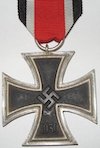
             Perhaps the most famous and recognizable medal of World War II is the German Iron Cross. I’ve been a lifelong student of WWII all my life. I remember watching the hundreds of WWII films that were made in the 50s, and perhaps thousands since then, and more than one film has made reference to the Iron Cross. As a teen, I had a German couple who moved next door to my family in Dallas. He had served in the German Army as a photographer on the Eastern Front. He shared with my father and me many of the photographs he had taken. Until that moment, I did not know anything about the Eastern Front in WWII. You can see my published short story I wrote about meeting this German soldier in my blog post, “Like a Good German Soldier.” Sometime in the early 1980s, I once met a veteran in Berwick, Pennsylvania, who showed me a Luger and held an Iron Cross medal he had brought back from his service time in WWII.
As a teen at  W.T. White High School in Dallas, the only class I have memories of is my English class. Our teacher had us read three books that made a deep impression on me: Romeo & Juliet (she also encouraged us to see the 1968 film), The Red Badge of Courage (I still have that paperback), and All Quiet on the Western Front, of which three movie versions would be made–1930, 1979, and 22. I was fascinated to learn that the author, Erich Maria Remarque, was a World War I veteran and that the novel was semi-autobiographical.

My interest in the Eastern Front was further stimulated by reading Alexandr Solzhenitzen’s novel August 1914, as well as the numerous references I found in reading the three-volume set, The Gulag Archipelago. Fortuitously, I discovered Willi Heinrich’s novel,  The Cross of Iron, which was also made into a movie. (You can see the trailer below).  The title of my blog post, “I will show you where the Iron Cross grows,” is a quote from the novel and from the movie, which is said to be one of the highest-rated war films of our age.  From this novel, I moved on to Heinrich’s second novel, Crack of Doom. Heinrich was a soldier on the Eastern Front. This reading was followed by The Devil’s Guard, a historical novel about partisan hunters in Russia, who joined the French Foreign Legion and fought the Viet Cong in Vietnam.

Perhaps the longest and most revealing read about the Eastern Front in World War II was a memoir, The Forgotten Soldier by Guy Sajer. It is so well written and so full of sensory information that I could feel the hunger the soldiers felt as well as the bone-breaking cold of Russia.

Here are the covers for the books I have mentioned in this blog post:

HERE IS THE TRAILER FOR THE CROSS OF IRON MOVIE: 

A SAD WALK THROUGH A POTTER’S FIELD IN NEW ORLEANS: Part Two

A SAD WALK THROUGH A POTTER’S FIELD IN NEW ORLEANS: Part Two

An Excerpt from Persephone’s Underground by Rickey Pittman, Bard of the South

Holt Cemetery
The first thing you notice about New Orleans are the burying grounds – the cemeteries – and they’re a cold proposition, one of the best things there are here. Going by, you try to be as quiet as possible, better to let them sleep. Greek, Roman, sepulchers—palatial mausoleums made to order, phantomesque, signs and symbols of hidden decay—ghosts of women and men who have sinned and who’ve died and are now living in tombs. The past doesn’t pass away so quickly here. You could be dead for a long time.—Bob Dylan

Cora said, “Morticiawill be buried tomorrow in Holt Cemetery.”
Ophelia replied, “Holt Cemetery. Such a sad place—built by the city for the destitute, unclaimed anonymous bodies found in canals and especially for poor blacks. It could be that you and I may find ourselves buried there when we die. Some have described New Orleans as a giant necropolis, a city of the dead. I wish it was that simple.”

When they arrived at the cemetery gate, Ophelia took Cora’s hand, scanned the graves and whispered, “Cemetery, give me passage! Oh, cemetery, open the way!” She tugged Cora’s hand, and they entered the gate and found the grave dug for Morticia. They watched the cemetery workers unload the cheap wooden casket from the Coroner’s transport van, deposit it in the grave, and shovel the dirt onto the casket. When the van left, Cora set a Goth bouquet of red and black flowers on the grave. She tugged on her rosary and said, “Rest in peace, Morticia.”

As they left, Cora thought, This cemetery is nothing like the others in New Orleans. All the graves here are underground. “Look, Ophelia, this cemetery is a jumbled mess. Some sections need mowing.” She picked up a stuffed rabbit lying by a wooden tombstone. The adhesive lettering said the grave was that of a little girl. The thought of a parent having to bury their child in a potter’s field made her sad. Across the cemetery, she noticed a young black mother kneeling by a grave. Her lips were moving as if she were praying. She followed Ophelia to a large, ancient oak in the center of the cemetery, passing homemade shrines strewn with personal items families had left to honor the deceased.

“It’s a miracle this cemetery has lasted this long. It floods during heavy rains, and it reached capacity long ago. It’s still in use, but every time they bury someone, they have to exhume someone. Some graves have been used by one generation for several bodies, one on top of the other. Many buried here died violent deaths, others from drugs or alcohol or natural causes. Certainly, there are lost souls here who will never rest in peace. Some notable people too. Let me show you where a few are buried.” She took Cora by the hand. “Most of these I’m sure you haven’t heard of, but the more you get to know New Orleans, the more you’ll appreciate them.”

She pointed to a gray plaque leaning against the oak. “This is the memorial for Robert Charles, whose act of murder and his death caused the Race Riots of 1900. Ahead are the graves of some New Orleans blues and jazz musicians, popular in their performing days, but forgotten at the end of their life—Babe Stovall, Jessie Hill and Charles “Buddy” Bolden.

“Have you ever heard of them?”

“No,” Cora said, “But I will try to learn about them.”

“Yes, learn about them and listen to their music. They were great musicians, but their burial shows how quickly people can forget. Just think: If you hadn’t come to New Orleans as Cora, you would never have known about them. So many stories are buried here. Ahead, there’s graves for the dead of the Upstairs Lounge. It was a gay club that an arsonist set fire to. And there’s thousands buried here whose stories we will never know.”

“It is indeed a sad place, Ophelia.” She pointed to a brick building. “What is that?”

“It’s an old crematory oven. I suppose because of how crowded the cemetery is, some bodies were cremated and their ashes buried somewhere.”

“It’s full of trash. Only a few graves seem to be cared for.”

“Families are told that they must keep up the graves or the grave is taken over by the city and used for someone else.”

“I didn’t know there was so much history here,” Cora said.

“Yes, there is much history about Holt Cemetery, but it is good for us to remember those buried here, both the nameless and known, and for us to come here to meditate on life and death. And it’s still in operation. Twenty people are buried here each day.”

“I think I will never look at graves the same way after today. Thank you for bringing me here. Maybe I should come here at night? What do you think I would see or hear?”

Ophelia stopped walking and tugged on Cora’s hand. “I came once at night, but I swore I’d never do it again. Get that idea out of your head.”

“Okay,” Cora said, but as she left the cemetery, thinking of her father, she wiped a tear from her eye, kissed her hand, and touched a tombstone that had this inscription:

Just whisper my name in your heart, and I will be there.

A SAD WALK THROUGH A POTTER’S FIELD IN NEW ORLEANS: Part One

A SAD WALK THROUGH A POTTER’S FIELD IN NEW ORLEANS: Part One

Many cities have long had cemeteries known as potter’s fields, used to inter the indigent, the nameless, unclaimed,  suicides, the unidentified, and strangers. Many are buried in layers, and in a few there are mass graves of those lost in epidemics or war. Some, potter’s field cemeteries have suffered from neglect, vandalism, and grave robbers.

I first encountered a potter’s field cemetery in the book of Matthew.  Here’s that Biblical account in Matthew 26:14 and 27:3-10 (American Standard Version).

Then one of the twelve who was called Judas Iscariot, went unto the chief priests and said, What are ye willing to give me, and I will deliver him unto you? And they weighed unto him thirty pieces of silver. . . . Then Judas, who betrayed him, when he saw that he was condemned, repented himself and brought back the thirty pieces of silver to the chief priests and elders, saying, I have sinned in that I have betrayed innocent blood. But they said, What is that to us? See thou to it, and he cast down the pieces of silver into the sanctuary, and departed; and he went away and hanged himself. And the chief priests took the pieces of silver and said, It is not lawful to put them into the sacred treasury since it is the price of blood., And they took counsel, and bought with them the potter’s field to bury strangers in, Wherefore that field was called, The Field of Blood [Akeldama in Aramaic] unto this day, Then was fulfilled that which was spoken through Jeremiah the prophet.

HERE is an excellent blog article about Potter’s Field Cemeteries.  This post is Part One of a post describing how Cora, a character in my novel Persephone’s Underground, experiences a walk through Holt Cemetery in New Orleans. Part II will be an excerpt from my novel, Persephone’s Underground.

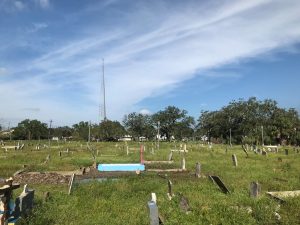
(Photo is from Holt Cemetery New Orleans Facebook page.)


Voodoo in New Orleans: An excerpt from Persephone’s Underground

A Vodou Dance in New Orleans

To fight evil, you have to understand the dark.—Nalini Singh
Now if I don’t meet you no more in this world, then I’ll, I’ll meet you in the next one, and don’t be late, don’t be late, cause I’m a voodoo chile—Jimi Hendrix

 Ophelia said, “It’s time for us to go to the dans. Lorcán will drive us. Rosalie Alley is a home to vodou practitioners.  The congregation is known as Guera Anciene. Appropriately, the building they meet in lies between Piety and Desire Streets. Most tourists never find it.”

They walked down the grassy alley toward a bright green building surrounded with a peristyle, passing houses with vodou graffiti, symbols of an ancient African religion and under branches of beautiful, massive oaks. They walked alongside other worshippers, many dressed in white dresses and turbans with red neck scarves. “Who are the people in white?” Cora asked Ophelia.

“Initiates,” she replied. “You might see some of their initiation rituals tonight. The first step is head washing, which deals with the spirits in a person’s head. The second step is kouche, when a person enters a time of seclusion. In that seclusion the initiate symbolically dies before he or she returns to the outside world. Finally, the initiate is given a sacred ason, a beaded rattle with a bell attached, which gives the initiate strength to start healing work and to summon the spirits.”

As they approached the green house, Cora wondered how one becomes an initiate. For the first time in her life, Cora heard the muffled sounds of conga drums and Haitian chants and the tumbao rhythm was  surprisingly stirring. When they entered, Cora whispered, “Is this their church?” She looked at the plain wood floor. “There’s no chairs.”

Ophelia said, “No one will be sitting. It’s a simple church, much like the many one will see in Haiti. One difference: The high priestess for this congregation is a white woman. You’ll see there’s no need of chairs, but at least the ceiling fans are working tonight.”
They paused by a candle-lit altar on which lay a human skull, some bones, a bottle of Klérun rum, a machete, a carafe of water, a comb, chalk symbols on a small chalkboard, an icon of the Black Madonna and a few other Catholic icons.  Several vodou flags, and banners called drapo, hunt on the walls, each decorated in beaded vévé, symbols and diagrams used to represent the spirits.  A man stood by the altar with his eyes closed as if he were in meditation, holding a coned object in his hand

“What’s that man holding?” she asked Ophelia.

“It is a paquet congo, a powerful amulet made of magical ingredients used for healing. Very difficult to make.”

Cora contemplated them and said to Ophelia, “I have much to learn. We can talk later, right?”

“Of course.” Ophelia set a bottle of rum on the altar as her gift, closed her eyes, and whispered, “When I am right, the magic prevails.”

There were three conga players, each with drums of different tuning, and each following his own secret syncopated rhythm designed to create a passageway to the spirit world. I’ve never heard anything like this, Cora thought. The rum-soaked musicians began with slow rhythms and then increased it to invite and honor the Iwa in attendance.

“The ritual dans is beginning. It begins around the poto mitan.” As worshippers began to dance around the center pole, Cora heard prayers and chants offered in the Haitian Kreyòl, and the white priestess drew some symbols in cornmeal on the floor and then poured out some rum. Two worshippers whistled shrill cries on their wooden carved whistles. She heard the devotees call on names she did not recognize—Erzulie Freda, La Sirène, Marassal, and Bondieu. It was at that moment Cora saw the lady she believed must be the high priestess. She was dressed in a long, flowing dress and white scarf on her head with an ason gourd rattle in her left hand. The rattle was decorated with coral and snake bones.

The drummers muted their music as the priestess held up both arms and said, “As we begin tonight, we invoke the blessing of Papa Legba, who stands at the spirit crossroads, open the gates between us; speaker of all human languages, guide and help us as we communicate with the Iwa tonight!”

The three drummers increased both the volume and speed of their rhythms. Cora whispered to Ophelia, “I’ve never heard drumming like this.”

“Ah, the rada music. Drums are sacred to us. There are three different drums there: the largest drum is the manman.”

Cora thought the manman drum to be nearly three feet tall. The player stood and played it with a wooden drumstick in one hand and the other with his bare hand.
Ophelia continued. “The other two drummers who are seated play the segond and the bula.

Cora felt her pulse rise with rising drum rhythms. More dancers, including Ophelia, joined those circling the poto mitan, twirling, dipping, and bowing. One woman fell to the ground convulsing. Helped to her feet by others, she resumed her dance, but her eyes had rolled upward so that only the whites of her eyes could be seen, as if she had been hypnotized.

Ophelia left the circle of dancers. Cora handed her a bottle of water she plucked from an ice chest by the altar.

“Did you see the woman ridden by the Loa?” Ophelia asked.

Cora assumed she meant the woman who fell down in convulsions. She nodded.                                                      “Is she okay?”

“She is fine, and she is honored that the spirit chose her. Tread carefully, Cora. The spirits may choose you.”

The priestess approached them. She took Cora’s hand and smiled. “You are welcome here. This is your first time to attend our worship.”

“Yes,” Cora said, “And thank you. Ophelia brought me.”

Ophelia said, “Mambo Sharon, Cora is my friend, new to New Orleans, She carries some sadness and burdens in her heart. I was sure that you could help her.”

The mambo touched Cora’s cheek and said, “Cora, I hope you will learn from tonight’s service, I will pray that your wounded heart will be healed, and I want you to believe that I am your friend and will come to your help should you ever need me. I’ve a little botánica and art gallery in the French Quarter. Please come and see me. We can drink tea and talk.”

Cora, wondering how the priestess could sense her hurt,  felt herself choke and said, “Thank you. I will.”

When the priestess left them to return to the worship, Ophelia put her arm around Cora and gently embraced her. “You’ve found yourself a new friend. Mambo Sharon is one of the most powerful women in New Orleans. There are ten vodou priestesses in New Orleans, and even more in the swamps in surrounding parishes. Mambo Sharon is probably the most powerful.”

Cora said, “Do you think I will need her help?”

Ophelia bit her lip and looked deeply into Cora’s eyes. “Yes, just as I myself needed her help a few years ago. Take off work tomorrow afternoon and go to her botánica and art gallery. It will be such an adventure for you. In her garden she has flowers and plants from Haiti.”

“I don’t want to leave you without help.”

“Don’t worry. You can work till after lunch and then go to her botánica. You won’t regret it. She is a healer of one’s body and heart.”

Cora listened to the prayers and songs of the worshippers in English and French kriol and watched worshippers dance and fall into possession trances, their pupils dilated and their bodies contorting wildly. One shouted, “Papa Legba, open the door Antibon for us to pass now!”
      The drummers, their hands swollen and bruised, played on without pause till dawn. When the sound of the drums faded, the worshippers gathered and silently faced the open door, and as the sun rose, a beam of light fell upon the congregation like a kiss.   

An Excerpt from Persephone’s Underground by Rickey Pittman


THE LAST TIME CORA’S STUDENTS SAW HER

THE LAST TIME CORA’S STUDENTS SAW HER
Imagine you’re a teacher who one day does not return to her school. Nothing in your classroom is missing. Your personal effects, checkbook, grade book, and photos of your husband and friends lie scattered on the desk. When students ask where Miss Cora is and when she will be back, no answer is given. After a week, the students accept the sad silence and the fact that Miss Cora will not return.
Learn more about Cora’s vanishing in Persephone’s Underground, a new novel by Rickey Pittman, Bard of the South. Also available on Amazon. Please share my post!
https://booklocker.com/books/14047.html

The Wild Girl of Catahoula by Yvette Landry, a Review by Rickey Pittman

The Wild Girl of Catahoula by Yvette Landry

A Review by Rickey Pittman, A Bard of Acadiana

It was at the Cajun Dome, at the Jr. League Tinsel & Treasures Holiday shopping event, that I first met Yvette Landry. Arcadia/Pelican Publishing had sponsored both of us for a book signing, September 25-27, 2025. Also, it was there that I first discovered her fine juvenile-fiction, action/adventure book, The Wild Girl of Catahoula. I read it as soon as I returned to Monroe and knew I had to write a review of this fine story.

Though I knew of Catahoula Parish and Catahoula Lake in LaSalle and Rapides Parishes, I did not know of the small Catahoula community in St. Martin Parish, just outside of the Atchafalaya River Basin, the setting of the story, a perfect setting for the story of the wild girl, “a place where strange things happen where the black trees grow.”

Written in a first-person account, told by a twelve-year-old girl (presumably Yvette herself) as she listened to the wild girl’s haunting story as told by Pop, her grandfather. In addition to being a very good spooky story, the story gives several insights into the stories and culture of the Cajun folk who worked, lived near, and in the spooky Atchafalaya River Basin. Though it was years ago when Pop had first seen the wild girl, he is obviously still haunted by the experience and memory. The reader may also be haunted by the story. At the Cajun Dome, Yvette shared with me that this is a true story and that the wild girl had also been seen by others in at least two other locations in that part of Louisiana.

The Wild Girl of Catahoula is well illustrated by Cullen Bernard with ink and pen drawings that closely follow Landry’s excellent narrative. There is also a glossary of Cajun and Atchafalaya River Basin words that will provide excellent enrichment for young readers, or even for adults who may be new to Louisiana vocabulary. This storybook would be a great addition for a class or book club discussion, as it closes with a Reading Guide with fourteen thoughtful discussion questions. ‘

As an extensive reader and writer in the horror genre, I would recommend Landry’s story for anyone interested in spooky stories of Louisiana.

ABOUT YVETTE LANDRY: This beautiful, award-winning author is from Breaux Bridge, Louisiana, and is a noted performer who was inducted into the Louisiana Music Hall of Fame. You can learn more about her at her website: https://yvettelandry.com/about-yvette/

REVIEWER’S BIO: Rickey Pittman, the Bard of the South, is a storyteller, author, songwriter, and folksinger. He was the Grand Prize Winner of the 1998 Ernest Hemingway Short Story Competition and is originally from Dallas, Texas. Pittman presents his stories, music, and programs at schools, libraries, organizations, museums, historical reenactments, restaurants, banquets, and Celtic festivals throughout the South. Learn more about Pittman at: https://bardofthesouth.com

page2image8657824  page2image8657200 page2image8656992