Two Irish Units during the War Between the States

With St. Patrick’s Day approaching, my mind is on the Irish in the Civil War. I found a site devoted to the 7th & 30th Missouri Volunteers: Missouri Irish Brigade of Civil War Re-enactors. You can find the site here:

According to the website, the 30th were “Known as the “Shamrock Regiment”  the 30th Missouri Volunteer Infantry [and were] mustered into United States service, at St. Louis, Missouri in October of 1862.”  The unit was part of Sherman’s Army and saw action at Chickasaw Bluff, Vicksburg, Jackson, Clinton, Natches, Vidalia, Mobile, and were after the war were assigned guard duty in Texas.

The” Irish Seventh” were “mustered into United States service at St. Louis, Missouri in June of 1861.”

Both units were consolidated by the end of the War and the consolidation continues today in the reenactment unit. If you go to their site, you can see a photo of the regiment’s flag, a painting created and submitted to the site by Aaron Gilmore. Here is a description of the flag in the Boston Pilot, an Irish Newspaper that existed in Boston Mass. during the Civil War. The article was ran on July 12, 1862.

“A splendid standard for the 7th Missouri (Irish) Regiment, painted by Somerby was exhibited at the Pilot bookstore, last week. It is painted on green silk of beautiful color and texture, and measures six feet by six feet six inches, in one piece. On one side is the Irish harp, guarded by a savage looking wolf dog surrounded by a wreath of shamrocks, and mounted by an American eagle, and supported on either side by flags and implements of war. A golden halo shoots from out and over the whole. On the reverse is a sunburst in all its glory, with the Irish war cry for a motto – “Fag an Bealac!” A beautiful gold eagle mounts the staff; and nothing is lacking about it which constitutes a first class standard.

If you go to this site,  you can learn about the 28th Massachusetts Volunteer Infantry 4th Regiment in the famous Irish Brigade. This site will tell you all about the regiment’s history, weapons, flags, battles, and casualties.  It will also inform you of the recreated 28th that in the world of Civil War reenacting, represents the unit. The site has pages that will tell you of the 28th today, some vital information about Civil War reenactment, uniforms and equipment, recommended sutlers, their campaign schedule and an image gallery. You can also find out how to join the unit should you have the desire and means to do so.

In case you’ve never seen them, here is a famous Civil War song entitled, “The Boys of the Irish Brigade.” It’s one I often do in my Civil War programs at schools and libraries.

What for should I sing you of Roman or Greek,
Or the boys we hear tell of in story?
Come match me for fighting, for frolic, or freak,
An Irishman’s reign in his glory;
For Ajax, and Hector, and bold Agamemnon,
Were up to the tricks of our trade, O,
But the rollicking boys, for war, ladies and noise,
The boys of the Irish Brigade, O!

What for should I sing you of Helen or Troy,
Or the mischief that came by her flirting?
There’s Biddy M’Clinchy the pride of Fermoy,
Twice as much of a Helen, that’s certain.
Then for Venus, so famous, or Queen Cleopatra,
Bad luck to the word should be said, O,
By the rollicking boys, for war, ladies and noise,
The Boys of the Irish Brigade, O!

What for should I sing you of classical fun,
Or of games, whether Grecian or Persian?
Sure the Curragh’s the place where the knowing one’s done,
And Mallow that flogs for diversion.
For fighting, for drinking, for ladies and all,
No time like our times e’er was made, O,
By the rollicking boys, for war, ladies and noise,
The boys of the Irish Brigade, O!

From the Book of Irish Songs, by Samuel Lover
(Paul A.Winch, 1860)

A New Children’s Song by Rickey E. Pittman

Yesterday at the East Texas Library Summit, I met another author, Marvin S. Mayer, whose book, Sammy Squirrel and the Sunflower Seeds,  tells the story of Sammy the squirrel’s adventures after being captured and relocated to the Squirrel Relocation Center, and his courageous attempt to return home while his father searches for him at the same time.  I was so impressed with this author and his children’s story that I wrote a song on the spot. The conference videotaped the song and I think it will be YouTube soon. I’ll also post it on my blog and my Facebook page.  I like this song and plan to work it into my children’s program.

SAMMY THE SQUIRREL

(A children’s song by Rickey E. Pittman)

Sammy the squirrel went out to play

A wire box trap was in his way

He started to just pass it by

But he saw the sunflower seeds inside.

He entered the cage at an open end,

The door slammed shut, trapping him in

Sammy cried “Mother, what will happen to me?”

Then they took him to the *SRC

CHORUS:

Sammy the squirrel lived in a Texas town,

Climbing in trees and rolling on the ground

Leaping and flying so wild and free,

Sammy would work for sunflower seeds.

Sammy said enough of this SRC

I’m leaving here and you can’t stop me

It’s hard to survive when you’re on your own,

I’ve got to find my way back home.

Harriette the squirrel said, Listen to me.

Get off the ground if you want to be free.

Travel in the trees and telephone lines,

And move through the air so clean and fine.

CHORUS:

*Squirrel Location Center

You can order or look at this children’s chapter book here:

Stonewall Jackson’s Black Sunday School

I’ve a new book that I’ve written to honor one of the great heroes of the Confederate South–Thomas J. “Stonewall” Jackson. The book is called, Stonewall Jackson’s Black Sunday School (Pelican Pub.) It can be preordered from Barnes & Noble and Amazon and in January printed copies will be available. I plan on telling this story to as many people as possible, not only to honor Jackson, but to show those who are determined to demonize the South and Southerners that the issue is really much more complex than the media, the politically correct, and enemies of the South have presented it. A history teacher I respect described those who have negative reactions to or who seek to minimize or dismiss the significance of Jackson’s Sunday school as people who “cannot allow a person at that time to be simply doing what God has called him to do. If the person is white, he must have another motive (a hateful one) for any good he does.” Jackson’s Sunday School, like the story of Jim Limber, undermines the stereotype people have in their minds about the South and race.

Here is the story of Jackson’s black Sunday school in a nutshell: In the autumn of 1855, Jackson began a colored Sunday school in Lexington, VA. He did this under the guidance of the Lexington Presbyterian Church and in spite of and defiance of social mores and laws. Not only did Jackson teach the black folks who came to the school the gospel, he also taught the students to read and write.

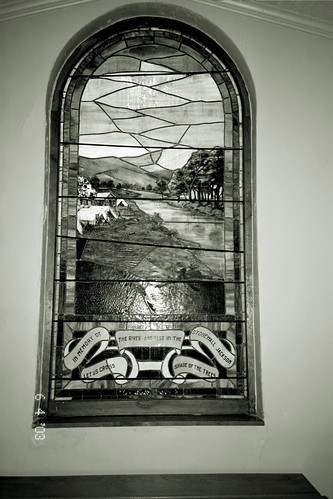
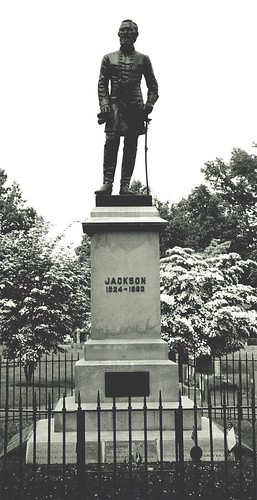
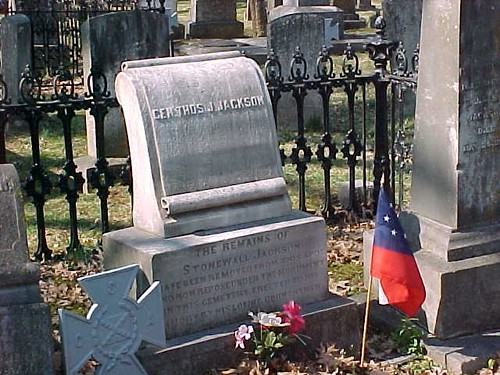
If you go here, (and please do) you can find a fine article telling the story of Jackson’s influence on that Lexington black community.  One of the students there became a pastor and wanted to honor Jackson, so he raised funds to construct a window in his congregation, the Fifth Avenue Presbyterian Church. in Roanoke, Virginia. You can see that window’s image in this post.  I’ve also posted images of a statue and gravestone honoring  this great Christian man.

To understand Jackson’s work and influence on the Lexington black community, I would recommend that you read, Stonewall Jackson: The Black Man’s Friend by Richard G . Williams Jr.  Like Williams, I was inspired by Jackson’s life and love for people–whether they were black or white–and thought the story of Jackson’s work should be told.  I thought a children’s book would be the best medium to use. My artist is Lynn Hosegood and she did a fine job illustrating the story and her art reveals the sensitivity and historical research that the account deserves. I’ll have a future post with samples of her artwork.

Statue of Stonewall Jackson

Statue of Stonewall Jackson

Stonewall Jackson Gravestone

Stonewall Jackson Gravestone

Water for Elephants by Sara Gruen: A Short Review

Water for Elephants by Sara Gruen: A Short Review by Rickey Pittman

When my friend FB friend Dena, who works for Books-A-Million in Sherman, Texas, recommended this novel, I decided I would give it a read. I knew that Water for Elephants (Algonquin Pub.) was a bestseller, that it had acquired many good reviews, but because it dealt with the circus, I was hesitant. After having read it, I must say that it is one of the best books I’ve read this year.  The beautiful author’s site is here, http://www.saragruen.com/home.html and I hope you will visit it to learn more about her and her other books.

Here is a brief summary of the novel which I lifted from her website:

As a young man, Jacob Jankowski was tossed by fate onto a rickety train that was home to the Benzini Brothers Most Spectacular Show on Earth. It was the early part of the great Depression, and for Jacob, now ninety, the circus world he remembers was both his salvation and a living hell. A veterinary student just shy of a degree, he was put in charge of caring for the circus menagerie.
It was there that he met Marlena, the beautiful equestrian star married to August, the charismatic but twisted animal trainer. And he met Rosie, an untrainable elephant who was the great gray hope for this third-rate traveling show. The bond that grew among this unlikely trio was one of love and trust, and, ultimately, it was their only hope for survival.

Here are my own personal observations:  I learned much more about the “circus” than I expected. Gruen’s extensive research into the circus and Depression-era America was obvious, as was her ability to describe the human condition–in the words of one reviewer–in the “pathetic grandeur of the Depression-era circus.”
Told from the flashbacks and viewpoint of an old Jacob, the novel reveals the author’s understanding of what it means to be old and a resident of “assisted living” and this, because of dealing with my own father recently, endeared me to the storyline.  One could construct a circus glossary from the terms the author weaves into her story.

This was the last book I will read in 2009, and I think it was a proper and inspiring choice. I’ve only been to one circus–Ringling Brothers in Dallas, long, long ago, but I feel I understand those who work the circus much better. There is an interview with the author included as well as study questions should you read this with a group. There are photographs related to the circus scattered throughout, and so many good lines in her prose that I’m hesitant to try to list them all. Here are a couple of my favorites:

Jacob says he is “observing as the ghosts of my past rattle around my vacuous present” ( 13).

After he first makes love to Marlena, he says, “I am afraid to breathe in case I break the spell” (273).

In short, I found this novel to be exceptional.

Georgia Political News: Ray McBerry

Candidate Rising Like a Meteor in the Governor’s Race

(ATLANTA, December 22, 2009) — Having won several polls in the Governor’s race across the state in the past month, Ray McBerry’s campaign continues to pick up steam across the state.

In the past month, McBerry won first place in the governor’s race straw poll conducted in Tifton the week following two candidate forums in south Georgia, one in Tifton and another in Valdosta. Even Austin Scott, a native of Tifton, came in second to McBerry among the seven Republicans.

Meanwhile, Ray McBerry scored overwhelming victories in the online polls for the Governor’s race that were conducted by both the Augusta area Young Republicans in east Georgia and the Paulding County GOP in west Georgia.

In north Georgia’s Walker County, the McBerry Campaign came in second place in the Republican party’s straw poll, being bested only by Nathan Deal, in whose “back yard” the straw poll was conducted.

For several months now, there have been record turnouts each time that Ray McBerry has spoken at different county GOP meetings across the state, leading to an increase in the number of speaking invitations from other county chairmen.

Additionally, Ray has been invited to be the “kickoff” speaker for nearly a dozen ” tea party patriot” groups springing up around the state — groups who are looking for candidates who are not part of the current Democrat and Republican establishment. The most recent of thes e events was this past Thursday evening in Dalton in which approximately 200 people turned out to hear Ray speak on the subject of “States’ Rights.”

The record turnout at both Republican-sponsored events and these “town hall” type meetings every time that Ray McBerry is invited to speak have certainly gotten the attention of many within the Republican Party. Being called “the best public speaker in Georgia today” by a number of statewide candidates, Ray’s message of “States’ Rights” is resounding incredibly well in all areas of the state and among all groups, including “blue dog” Democrats, Libertarians, and Independents, as well as traditional conservative Republicans.

The McBerry Campaign team continues to grow with each new week and is the largest volunteer organization in the governor’s race among both Republican and Democrat contenders. With the rapid growth of the campaign, the success in numerous recent polls, and the increasing demand for his speaking across the state, Ray McBerry appears to be rising like a meteor in the Republican race for Governor.

For more information or to contact Ray McBerry’s campaign about interviews and speaking engagements, please visit the campaign website at http://www.GeorgiaFirst.org

A Soldier’s Christmas by Jeff Talmadge: Chords and Lyrics

With Christmas coming on, I wanted to share the lyrics of this Jeff Talmadge song that I learned from his Blissville CD. I plan on playing it for the Scottish Society in Shreveport this Saturday. During the holidays, please remember our soldiers . . .

A Soldier’s Christmas by Jeff Talmadge: Chords and Lyrics

Verse 1:

The guns were silent and the night was still *C G

And we’d just come in from patrol C G

We never thought that we’d spend Christmas here Bm C

We thought that we’d be going home  C D (There is a walk down here)

Verse 2

We sang Christmas songs that we all knew C G

And we ate turkey from a tray C G

We never talk about not coming back Bm C

It’s best to treat it like any other day. C D

CHORUS:

And in between the clouds of smoke G C D G

There’s Christmas in the air G C D

It’s Christmas in this tent tonight G C D G

It’s Christmas everywhere.  C D G

(Final verse add)

Em C D G

Verse 3:

We took Basra just by driving through

And we took Baghdad in a day

The day the war was over was the day our war began

And they can’t tell us how long we will stay

Verse 4:

And there’s an empty bunk right next to mine

It’s where my buddy used to sleep

They’ll be sending somebody to take his place

They say he’ll be here sometime late next week

CHORUS:

Verse 5:

So we strung some lights from pole to pole

With ornaments of cartridges and shells

We clean our guns so when the morning comes

We’re not afraid to walk through hell

CHORUS:

*Note: Jeff finger picks it and as he often uses a D tuning, it may not be a true “C” chord, but an adaptation. If you hear the song and finger pick, you’ll know what I mean.

An Interview with Will Kimbrough

An Interview with Will Kimbrough

When I first heard Will Kimbrough on the Americana music cable channel, I was so impressed and I determined that I would learn about this man and his music. I wrote him about some lyrics for his song, “Interstate,” and that was when our correspondence began. His website is at http://www.willkimbrough.com/ and you can find out much about him there that I don’t have the space or time to cover, including his touring schedule, photos, and music. For example, his bio speaks of his work with such greats as Rodney Crowell, Adrienne Young (whose songs are also mentioned on this blog), and Jimmy Buffett. A guitarist, singer, writer–he is an important voice of Americana music. Will graciously consented to an interview and here are the results of that.

1. When did you begin writing songs (and I would assume poetry)? Tell my readers about your early music.

I got my first guitar when I was 12 and starting writing songs not long after that.  I started writing mainly because I could not figure out my favorite songs by ear.  When I started figuring out my favorite songs (Allman Brothers, Hendrix, Kiss, Stones, Aerosmith, etc), I stopped writing for a couple of years.  Then I started back at about 16, and never stopped.  I was really into your basic classic rock, and that was a good foundation.  But hearing artists like The Clash and Elvis Costello made me want to write songs.

2. What is your song writing process?

I try to write every day.  Sometimes, I am sitting with a guitar in my hand, or sitting at a piano, with a notebook and a pen, but a lot of days I am busy with kids and school and family and work, like studio work, or I am on tour and traveling from place to place.  During those times, I write down ideas, record snippets of song ideas, play guitar or piano whenever I have a few spare minutes.  Those little ideas have grown into some of my favorite songs.  Since I have become a husband, a Dad, a busy working musician, I have tried to make writing simply a part of every day.  I used to get frustrated if I was too busy to write, but now I just make the most of little moments and then try and make the best ideas into full-fledged songs when I have the time.

3. What advice would you give folk singers and songwriters today?

Make great music and don’t steal my gigs.

4. What musicians and songwriters were/are the greatest influence upon you?

The icons, of course:  Dylan, Beatles, Stones, Who, Kinks, Chuck Berry, Muddy Waters, Hank Williams, Stax, Motown, Nashville, New York, LA in the 60s and 70s, punk rock, new wave, the great Texas songwriters, REM, Richard Thompson, Jamaican music, and all my great musician friends.

5. What projects are you working on currently?

DADDY “For a Second Time” came out in June; Jimmy Buffett’s “Buffet Hotel” comes out December 8th; my new solo CD, “Wings”, comes out February 23rd.

6. What trends do you see in Americana  and folk music happening today?

A lot of younger players have embraced some of the old time style.  And there are some pretty slick playing young bands.   But other than that, I don’t really know; i’m just listening for great songs with interesting arrangements that catch my ear, move my soul, make the hair stand up on the back of my neck.

7. Tell about your songwriting workshops.

I admit to being a dreamer and an optimist.  If I wasn’t, I would have a hard time with the life of a traveling singer and picker.  When I talk about the process at a workshop, I tend to be pretty pragmatic.  To me, the fact of the matter is this:  if you really love to write and sing songs, you will be writing and singing, no matter if you are embraced or ignored by the music business.  So I just try and give some examples of how I put certain songs together, try and let folks know how important it is to be both open-minded and self-critical, yet somehow remaining free spirited enough to let the craziest ideas have a chance to be heard and developed.  Be brave with your ideas.  I hope it helps somebody out there.

8. Is there anything else the readers of this blog should know about you and your music?

I’m out there on tour and in your local groovy record shop and online too.  I play out on the road as much as possible.  I try to make a mood, keep a groove and dance the hully gully whenever applicable.

Here is a photo from Will’s site. Please visit his website and listen to his music. You will not be disappointed.

Will Kimbrough

Will Kimbrough

Magdalene: by Guy Clark, Chords and Lyrics

Good news for my blog. Coming soon is an interview with one of my favorite Americana folk singers, songwriter Will Kimbrough. Be looking for it! Today I wanted to post the lyrics and chords for another song by Guy Clark that I learned tonight. I hope it helps anyone who has been wanting to learn the song.

“Magdalene” by Guy Clark

I ain’t lookin’ for trouble E, Abm, A
I can’t stay here tonight E, Abm, A
I got to leave here on the double E, Abm, A
If I want to see the morning light E, Abm, A
Don’t need no pistol for the tickets E, Abm, A
I’ve got just enough to get us down the line E, Abm, A
I don’t know what happens next E, Abm, A
Your guess is just as good as mine E, Abm, A

Chorus

Move with me, Magdalene C#m, B, A
I’m tired of the same old scene E, Abm, A
There’s a greyhound leaving at midnight A, B7
If you came with me it’d be like a dream E, A
Come on, Magdalene C#m, B, A
Move with me, Magdalene E, Abm, A

Verse

I’ve heard Mexico is easy
I wouldn’t stay here if I could
Don’t come along just to please you
Let’s go while the going’s good

Chorus

Move with me, Magdalene
I’m tired of the same old scene
Let’s go down to San Miguel
Let’s go be somebody else tonight
Come on, Magdalene
There’s a greyhound leaving at midnight
If you came with me it’d be like a dream
Come on, Magdalene
Move with me, Magdalene

A Note on America Inspired by How the Irish Saved Civilization

When I read, Thomas Cahill’s, How the Irish Saved Civilization, I was struck by a passage that I wanted to include in my blog, a passage that is of great relevance to America. As I listen to and watch our blundering politicians and policy makers (of both major parties–Democrats and Republicans), I can’t help but think that maybe my friends in the Libertarian, the Constitutional Party, and the League of the South are right: The American political system is broke and can’t be fixed. Here is Cahill’s quote:

“There are, no doubt, lessons here for the contemporary reader.  The changing character of the native population, brouigh about through unremarked pressures on porous borders; the creation of an increasingly unwieldy and rigid bureaucracy, whose own survival becomes its overriding goal; the despising of the military and the avoidance of its service by establish families, while its offices present unprecedented opportunity for marginal men to whom its ranks had once been closed; the lkip service paid to values long dead; the pretense that we are still what we once were; the increasing concentrations of the populace into richer and poorer by way of a corrupt tax system, and the desperation that inevitably follows; the aggrandizement of executive power at the expense of the legislature; ineffectual legislation promulgated with grew show; the moral vocation of the man at the top to maintain order at all costs, while growing blind to the cruel dilemmas of ordinary life–these are all themes with which our world is familiar, nor are they the God-given property of any party or political point of view, even though we act as if they were . . . .” (pp. 29-30)

Shape-shifting and the Bible

Shapeshifting and the Bible

“[T]he Irish believed that gods, druids, poets, and others in touch with the magical world could be literal shape-shifters”–Thomas Cahill

When I present my Scots-Irish program, with the more mature grades I sometimes talk about shapeshifting in ancient Celtic and druid thinking. Of course, the Celts were not the only culture to believe that humans and gods could take on other forms. For example, Native American mythology is full of tales that illustrate this. The world religions, even Christianity holds it out as a possibility.  For example in the Bible:

1. According to the Gospel of Luke, Chapter 3, the Holy Spirit descended in bodily form at the baptism of Jesus.
2. Also in Luke, Chapter 24, Jesus appeared in “another form” to the disciples walking along the road.
3. Think too of God speaking to Moses from the burning bush.
4. Balaam’s donkey talking must have something to do with this.
5. Satan himself is said to be able to masquerade as an angel of light. (II Corinthians 11:14)
6. Angels frequently took (some say still take) on the form of humans. Hebrews 13:2 reminds us to show hospitality to strangers because some entertain angels unaware of the fact they’re dealing with a heavenly messenger.
7. Even the idea of incarnation, God becoming flesh, seems to me to be a form of shapeshifting.

I think these references are instructive and reminders that the ancient world religions had more in common than we might realize.