Biden’s America: When Things Fall Apart
“He has put a knife on the things that held us together and we have fallen apart.” —Chinua Achebe
A few months into Biden’s presidency, it is stating the obvious to say that things haven’t gone well. The hatred for President Trump and the poison liberal ideology that resulted in Biden’s fraudulent election, a cracking economy, a power-mad Washington elite, and an increasing border disaster is, to borrow Achebe’s words, a knife that may sever America from a prosperous and happy future. The MAKE AMERICA GREAT AGAIN slogan is quickly changing to WE MUST SAVE AMERICA.
In fact, things are going so badly since the projected Golden Age of Biden has not materialized, the liberal and media emphasis has shifted once again to creating fear of another pandemic so that government can mandate masks and lock the whole country down again and then use the imaginary pandemic as an excuse to monkey with and cheat in elections as they did before because they know they cannot win another election otherwise.
They do not want Americans to have their country back.
Yet, there are many who think things are fine and do not realize the ship of our nation is sinking. We have charged full steam into an iceberg that has halted progress and ripped the bottom off unprecedented prosperity that existed just a few months ago.
I suspect the books of Charles Bowden are not read by many of our leaders or they would take the border problem much more seriously. The progress in halting the COVID pandemic is now jeopardized by the porous border allowing thousands carrying COVID to enter our nation, dispersing them at taxpayer expense through our nation, carrying COVID and other third-world diseases with them. In addition, dangerous gangs, known and convicted criminals, unprecedented quantities of drugs, and human traffickers follow like hungry wolves. Theodore Shoebat made a full-length documentary titled Hell Across the Border that reveals how gangs and death cults from Mexico have already come to America. There are already too many crime-ridden cities where travel, business, and living are not safe. That will only worsen if the present conditions are not corrected. Porous borders once helped destroy the Roman Empire.
Why are these things happening? Why is there a loss of patriotism? Why are people protesting law enforcement, kneeling during the National Anthem, praising anti-American groups like Antifa and Black Lives Matter, canceling bail, not arresting criminals, and releasing criminals? Why are hundreds dying because of violence in Democrat cities?
Why? Basically, too many are following media-fed fads. It’s a contagion of the bandwagon fallacy. It’s a sort of virtue signaling, the popular thing to do. Some support these measures because of monetary interests. Worse of all, there are many in the Washington elite who don’t care what happens to the citizens of our land as long as they don’t lose power. They are protected by their huge fortunes, by their walled compounds and private security, and by legal immunity and exemption from laws and mandates.
The hatred of people like President Trump and conservatives is irrational. People who scream at the sky, harass people in restaurants, tear down statues, are little different than the fanatical Muslims who likewise scream, chant, and harass people who differ from them. Fanatical Islam defaces century-old monuments and stones people to death for minor offenses.
What solutions are offered to correct our crime problem? Disarming citizens is not the answer. Defunding and dismantling police forces have already born poison fruit. There are now more large areas of cities where it is not safe to drive through or even live in. Raising taxes or depending on government bailouts certainly can’t be the answer.
Can you blame someone who wants to move to a safer, less taxed state?
Our political leaders waste time so they can argue about masks. Will the mandate to wear masks become our national dress code? They threaten fines and arrest for violations of their policies, but they tolerate riots and violence. They revoked President Trump’s executive orders out of spite with no explanation. They either don’t have the knowledge or intelligence to see or they don’t care about the contradictions.
There are several current, destructive issues that loom in America’s future:
1) Shutdowns. So many businesses have been permanently ruined. Too many will never be back. Many fear that another shutdown will break our nation beyond repair.
2) Travel by air, both locally and internationally, is already difficult, and in some cases impossible.
3) The English language is under attack from WOKE censors and political correctness.
4) Phantom of white supremacy. America is the freest nation on earth and a land where any person, of any gender, nationality, or race can reinvent him or herself and fulfill their dreams. All they need is a strong work ethic, determination, ambition, and to take advantage of the many resources our nation offers.
5) The race card, especially through Critical Race Theory, is being used to create a victim mentality and actually creates hostility instead of harmony.
6) Hypocrisy and double standards of those in political power.
7) The use and application of logic have vanished. People who cannot think properly are dangerous.
8) There is a fast-growing loss of work ethics, due in part to government subsidies. When people don’t have to work, they won’t.
9) Media has largely become a tool of the Democratic Party. True the number of conservative media alternatives is growing, but it will be a while before they can have an influence that can equal liberal media. Once upon a time I enjoyed PBS programs and selected upbeat shows like CBS Morning Show. I learned from them, was inspired by them, encouraged my students to listen to them. That is no longer true.
10) Celebrities and the Hollywood industry have stepped onto the liberal bandwagon, persecuting, blacklisting any who dare go against them.
11) Education is in real jeopardy. The power of the Teacher Unions is massive, resisting school openings. Higher education seems to be ignorant of history, resistant to the classics of literature, the dangers of communism, and principles of logic.
Of course, there is more than can be said, but perhaps this essay will be of some help to someone’s thinking. I think there’s no better closing for us to remember than this prophetic quote from Cormac McCarthy’s No Country for Old Men , “Ever step you take is forever. You cant make it go away. None of it. You understand what I’m sayin?”
Let’s hope our citizens and especially our leaders take the right steps.
–Rickey Pittman, 2021
 It is said by those who heard the tales from the ancients, the old men and women of Wales, who heard the story first from those who had memories of the Druids and even Arthur’s sword. It is said that on those late summer afternoons when the sun is still shining hot and strong and raindrops fall from the blue sky, fall warm on your skin, it is said that if you sit in a quiet place of rocks and trees and if you shut your eyes, you’ll hear a harp’s melody, soft and sad and sweet as a harper using golden strings.

 Until I picked up this book about the life and writings of Émile Zola, I did not realize how little I knew about French authors. The book is part of the Twayne World of Authors Series and had been discarded from a university library. My reading of the book was slow and deliberate and I marked phrases I liked, had to look up and research French words, historical events, and places–some of which I made marginal notes about.
 My research revealed that there are many websites, detailed books, and fine videos concerning Zola. Elliott M. Grant, the author/editor, spent many years researching Zola. The book is not intended to be an exhaustive biography, but it does include enough to help the reader to understand Zola and appreciate his literary work, which includes novels, short stories, poems, journal and newspaper articles, and dramatic works. The book includes chapter notes and references, a selected bibliography, and an index. My feeling is that the book is an easy reference and useful tool for one wanting to explore Zola and his world.













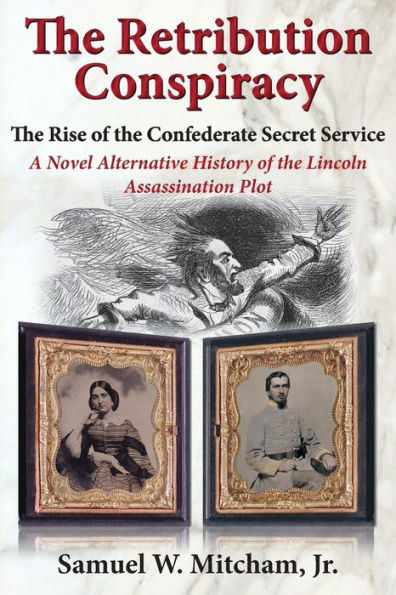 The full title on the novel cover is The Retribution Conspiracy: The Rise of the Confederate Secret Service. Below the cover title, one can read, A Novel Alternative History of the Lincoln Assassination Plot. Though I know a technique of writing historical fiction is to choose a topic, person, or historical incident that will interest people, I thought that this key moment in American history is a well-known topic that the general reading public knows something about. I wondered why he chose this topic. However, when I read this novel by Samuel W. Mitcham, I was truly surprised. I am an avid reader of history, fiction, creative nonfiction, and some historical fiction. I was hooked after reading the author’s introduction. After I completed a reading of this novel, demanded I write a review, something I’ve never done with a historical novel, though I’ve read and always admired Michener’s novels.
 While most Americans currently chafe under the increasing control of the rich, liberal elite political leaders in Washington who promote globalism, create a society of victims totlly dependent on government handouts, and while we are suffering the effects of the Cancel Culture and the WOK mentality that daily thrashes, punishes, and targets any person or business that does not tow the leftist, liberal agenda, I was delighted to discover a strong Nationalistic movement in Brittany. Bretons chafe under the control of the rich Parisian liberals. Bretons consider Brittany their home, their nation, not France. Visitors to Brittany will see the old Celtic flag of Brittany everywhere and in songs and celebrations, one can discover how passionate one’s love for one’s homeland, culture, and history can be.
 After the War Between the States, students of Louisiana history enter the dark and sad age of Reconstruction. In her fine book, Reconstruction in Louisiana After 1868, Ella Lonn, Ph.D., reveals how the actions and corruption of carpetbaggers (opportunist from the North), scalawags (reconstructed Southerners), military and government officials ruined the state’s economy, elections, and education. The purpose of this blog post is to share one example of how often in Reconstruction appointments and funds for education were misappropriated and funneled into the salaries of pathetically unqualified people in important educational positions. Lonn says this: “School directors were often unable to write their names. A letter (mailed Jan. 9, 1972) from the president of the school board of Carroll Parish, as printed in the National Republican, is so ungrammatical and misspelled that it is almost impossible to read it. Here is the actual letter: