Texas During Reconstruction

Texas During Reconstruction

There are few good things to be said of the North’s Reconstruction of the South. To illustrate the distress and victimization of the South after the War, I chose a quotation of Robert E. Lee. He had surrendered his army in hope of healing and peace for the South. Instead, the South received the punitive and wicked policies of Reconstruction. In August of 1870, Mr. Lee said to Governor Stockdale of Texas:

“Governor, if I had foreseen the use those people designed to make of their victory, there would have been no surrender at Appomattox Courthouse; no sir, not by me. Had I foreseen these results of subjugation, I would have preferred to die at Appomattox with my brave men, my sword in this right hand.”

Reconstruction was time of political and economic turmoil. It was also during Reconstruction that much of the violence that characterized our view of the West developed, even in our section of the State. Much research is available in which one can find many interesting outlaw vignettes.

For example, according to this site, “The Corners,” a was wild ticket located where four counties meet–Fannin, Grayson, Collin, and Hunt—[and it] became the hideout for desperados of many persuasions. The principal fugitives were ex-Confederates who claimed to have been driven to a life outside the law by the unfairness of military rule. The gang leader was Bob Lee, a Captain in Forrest’s Raiders.”
The outlaws also gathered in “Wildcat Thicket: The strip of land in Fannin and Hunt lying just east of ‘The corners,’ a solid mass of undergrowth–trees, briar brushes, thorn vines, and grass. Wildcat Thicket had served as a bandit refuge during the War. Its inhabitants included army deserts and draft evaders of both North and South.
“Bob Lee built his hideout of timber and black oilcloth in the densest part of the Wildcat Thicket. It was closer to the ground than a regular army tent, making it necessary for Bob and his followers to crawl into the shelter.”

For a thorough and balanced look at Reconstruction in Texas, read this article, “The World Turned Upside Down: Reconstruction in Texas” on this website:

For Women Writers:

I stumbled on a great site devoted to helping women writers. It’s called Women’s Writer Block.net There is a wonderful summary of Western TV movies with a section called, “Our Favorite Westerns.” Here you will find the history and details of many series. I found it by searching for information on the old series, Johnny Yuma, the Rebel (Nick Adams starred in the series). The site also has great tips on writing. The site says about itself: “The Women Writers Block is a place for women to post their writing — fanfic, poems, and non-fiction stories . . . No password, library card, shirts or shoes required.”

You can read more about Women’s Writer’s Block here:

Today, I’ll be in Ruston, LA, performing Irish and Scottish songs, then on to Bellmead. (See yesterday’s blog).

Prairie Vista Middle School Visit

This past April 23-24, I presented my Scottish and my Civil War programs at Prairie Vista Middle School that’s part of Eagle Mountain-Saginaw ISD. Tanya Plocica is the library media specialist there and she is doing an outstanding job. She said my program was a hit with the students and that they are still talking about it. You can see more of the school here:

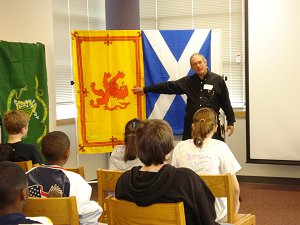
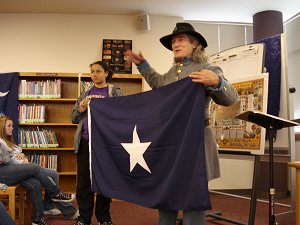
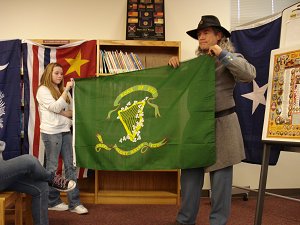
Here are three photos of my two days at the middle school, posted on the school’s website. I’m surprised at how interested the kids are in “flags” and how flags can be effective teaching tools. The first photo is of me in a kilt, teaching the students the difference between the Royal Flag of Scotland and the National Flag.

scottish flags

Here, I’m teaching them about the Bonnie Blue flag and my beloved Sons of Erin flag of the 10th Tennessee.

Bonnie Blue

10th Tennessee

By this next fall, I’ll have a Texas History program, and the flags of Texas will be a major part of that program as well, along with a show and tell table of objects and artifacts and of course, music.

PROGRAM NEWS 

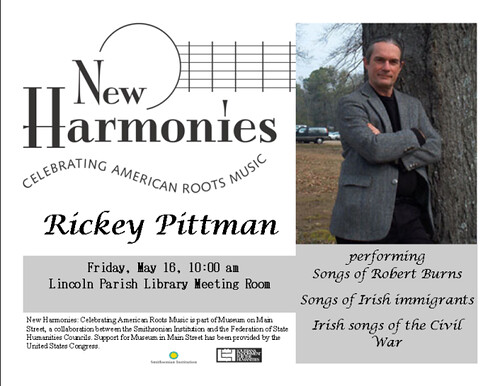
Tomorrow, I’ll be presenting my Scots-Irish program at the Lincoln Parish Library. Vivian McCain is the director there. Below is the library’s advertisement of the event. Here is the libraries site:

ad

From that event, I’ll drive on to Bellmead, Texas. You can read about the “Battle for Lake Bellmead” here:

I’ll be the speaker for a workshop at their annual Ladies Tea there. Here is my subject:

“Taking Pen in Hand”: The Importance of the Written Word to Living History

Designed to provide guidelines for reenactors to help their writing bring family history to life, to create historical fiction and Civil War poetry, and to develop the reenactor’s living history persona. I am so looking forward to this weekend! Say a prayer for good weather.

Fort Worth Photo Blog & Other Notes

Dixie Broadcasting Interview

I’m excited about my interview tonight at 9:00 CST with Dixie Broadcasting. Just last week, DixieBroadcasting reached another milestone in their history, with a total of 750,000 listeners since the station began on 1 June 2002. The Station’s ratings continue to soar, and they are now ranked at #41 out of 10,000+ Internet broadcasts by the largest rating service of Internet Radio stations in the world. Impressive! Here is their link:

FORT WORTH: Here are some more notes and photos from my weekend in the Stockyards at Fort Worth for the 8th Annual Frontier Forts Days, where we were (according to the brochure) able to “march back in time with the proud legends of Texas history and relive the sights and sounds of early frontier life and Indian heritage. Spectators were able to see camp life; displays of artifacts; parades; military drills; frontier baseball; mounted shooting competition; artillery and infantry firing demonstrations, Native American dance, costumes and stories; and so much more.

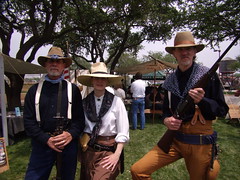
Here are two reenactors from the Spanish-American War, 1898, a war probably caused by propaganda and yellow journalism, yet from which we gained ownership of the former Spanish colonies of Puerto Rico, Guam, and the Philippines. These soldiers patiently discussed their uniforms and weapons and the life of a soldier during that war. I was most fascinated by their rifles, the five-round, bolt action 1896 Krag-Jorgensen, known as a .30-40. They claimed it was one of the best rifles ever made.
spanish amer

Here is the Frontier Brigade Band. They have a really cool website:

Here is a short description of them I lifted from their site:

The Frontier Brigade Band, also performing as The 1859 Marine Band, celebrates the Mid-Nineteenth Century American Brass Band Movement by dressing in uniforms of the period, and playing the authentic surviving musical arrangements of the time. Founded in 2000, the non-profit organization is comprised of over 20 musicians from the Fort Worth, Texas area.

band

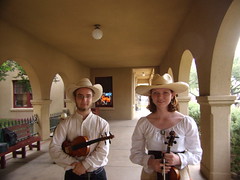
Here are two fiddle players, Ashley and Aaron.  They are with the Cowtown Opry. You can read about all the performers in this group here:

fiddle

Here is Jay Heflin and Celtic Crossroads. A first class Celtic group with an impressive repertoire.  Here is their site:

celts

With me are Michael and Sarah. They both work with Old Fort Parker. That website is here: Sarah tells the story of Cynthia Parker. I lifted a brief version of that story from the website:

On May 19, 1836, Comanche Indians attacked the fort; 5 were killed, 5 were captured, and the 21 survivors made their way to where Palestine is today. The most famous of the captives was Cynthia Ann Parker. She adapted to Indian ways and later married Chief Peta Nocona. Quanah Parker, the last great Comanche chief, who was involved in the Battle of Palo Duro Canyon, was the most famous of their three children.

parker

I had known the Cynthia Parker story all my life. A brief historical insight: After smallpox decimated the Comanches, they made a determined effort to rebuild their tribal numbers by white and Mexican captives.  So many captives were taken that some estimate that only 10% were of “pure” Comanche blood by the end of the 19th century. Cynthia’s story is a heart-breaking one. Stolen from her people twice.  You can read a good article about here:

Assorted News and Thoughts

Interview with Dixie Broadcasting 

Tomorrow, at 9:00 p.m. Central-Standard Time, and of course 10 p.m. (EST) I’ll be interviewed by Ray McBerry with Dixie Broadcasting.  The interview will be focussed on my newest book, Stories of the Confederate South, my writing, and of course, the South. You can go to this link, click on “Listen Now” and hear the interview. If you are a Southerner who is proud of his or her heritage, you need to make this station a regular part of your schedule.

Fort Worth Fort Trails Muster

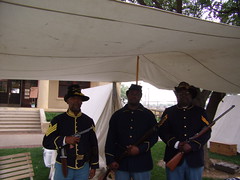
I was so impressed by this Fort Worth event. As usual when I attend anything connected to  “Living History”, I learned more than I intended.  Here are some more photos, illustrating what you can experience and learn at such events. First, here is a photo of Buffalo Soldiers.  They are top-notch reenactors, very knowledgeable and eager to teach young and old about soldier life on the frontier.  They operate out of Fort Concho, at San Angelo, Texas.

buffalo soldiers

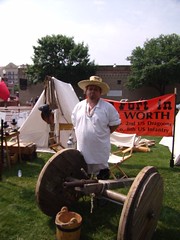
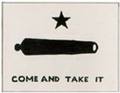
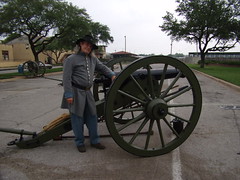
Next is a fellow with an exact replica of the famous “Come and Take It” six-pounder cannon at Gonzales, thought to be the first battle of the Texas Revolution. I’ve also included a flag that Texas ladies made in defiance of the Mexican Army who demanded the cannon be returned to them.  “Come and take it” became a motto of the Revolution.

gonzalez

come and take it

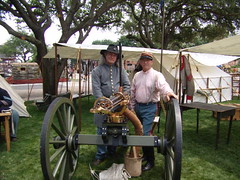
Here I am manning a hand-cranked Gatling Gun, invented by a Mr. Gatling in 1861. It was used only a few times in the Civil War by the Yankees. The South never used one, though I’ve been told they had some automatic type weapons of their own they were looking at using. The gun’s owner has the red cap and the red trim on his uniform, indicating he is with artillery.

gattling

Here I am with one of the four cannons fired at the event. Every time a cannon was fired, car alarms began singing from blocks away!  As always, folks were fascinated in the artillery and listened to the reenactors with interest as they explained the basic facts of firing Civil War period artillery.

cannon

Fort Worth Reenactors

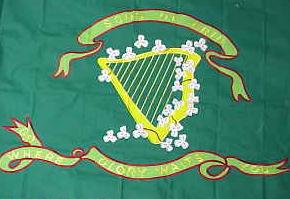
I met so many wonderful folks in Fort Worth and I am very grateful to the Texas Civil War Museum for sponsoring me to sign books. Reenactors from four different time periods and wars were represented in the morning parade –Mexican War, Civil War, Indian Wars, and Spanish-American War. I marched and proudly carried the flag of the Sons of Erin, the 10th Tennessee Infantry. Below is the flag I carried, and you can find information on the 10th Tennessee Infantry (then and their reenacting unit today) here:

sons of erin

A Soldier’s Sad Story . . .

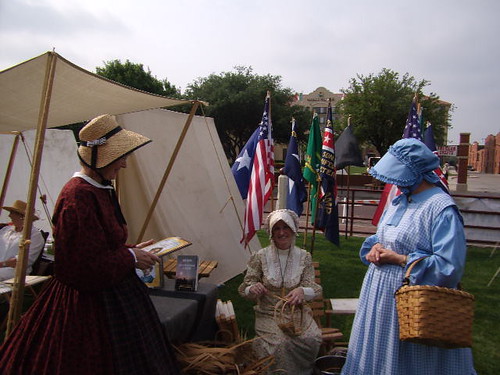
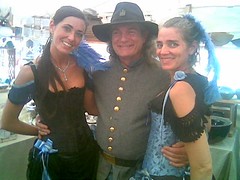
I should avoid Fort Worth . . . It all started with this Basket weaving girl . . .

baskets

Then there were the saloon girls . . .

saloon girls

Then, next thing I know, I’m in the caboose!

jail

Thoughts on Mother’s Day . . .

I returned to Louisiana late last night from a busy weekend: a program at Brownsboro Junior High on Thursday, a signing at the Hastings Bookstore in Tyler that night, Friday as an educational consultant for WorldandIschool.com, and Saturday at the Fort Worth Forts Trail Muster. I’ll have much to say about each of these events. Today, since it is Mother’s Day, I just want to reflect upon my mother. How can I describe her?

Her name is Jessie Faye Haines, born on October 12, (Columbus Day) in Karma, Oklahoma, a small Red River town that ironically was swept away by the river. She was an only child, raised mostly in Ivanhoe, Texas. As a mother, she was wise, sensitive, nurturing. All her life she has possessed a strong work ethic and is fiercely protective of and loyal to those she loves. She is why I love books. She would take me to the library every week, I’d max out my little library card without censorship of any kind, and then next week she’d take me again. She married my father when she was only fourteen, (he was 20) and they just celebrated their 60th wedding anniversary. They raised me in Dallas, where she worked at a beauty salon. She and my father (American Airlines fleet service) retired together. She is full of stories, living now in Kemp, Oklahoma. Once again the good Lord has placed her along that Red River that seems tied to her existence. I’m fortunate to have the mother I have, one I love with all my heart and one I admire and appreciate so much.

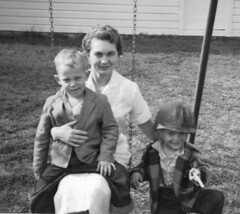
Here is a photo of my mom, myself and my recently deceased brother. I’m the one in the Army helmet. I always wore a hat of some kind. For a Mother’s Day gift, I had this photo placed on one of those Kodac memory boxes.

mother, jimmy, and me

These quotations were sent to me by Pamela, a GT teacher:

Marion C. Garretty
Mother love is the fuel that enables a normal human being to do the impossible.
Strickland Gillilan
You may have tangible wealth untold;/Caskets of jewels and coffers of gold./Richer than I you can never be -/I had a mother who read to me.
William Makepeace Thackeray
Mother is the name for God in the lips and hearts of little children.
Jewish Proverb
A mother understands what a child does not say.
Spanish Proverb
An ounce of mother is worth a pound of clergy.

Children of the Confederacy

On June 5-6, I’ll be presenting programs and my books at an event called, “Down Home in the Delta: 57th Annual Mississippi Division Children of the Confederacy Convention.” It will be June 5-6, Friday and Saturday, and in Greenville, MS, a city I’ve never been to, but have always wanted to see.

The Mississippi Swamp Rangers Chapter #950 of the Children of the Confederacy officially chartered on February 4, 2007. If you or someone you know are interested in joining this chapter, contact Chapter Director Alicia Bariola (through me at rickeyp@bayou.com) for more information.

The Children of the Confederacy is an organization of young people ranting from infants to the General Convention after their eighteenth birthday. These children are descendants of men or women who honorably served the Confederate States of America in the Army, Navy or Civil capacity.

The objects of the organization are:

1) To broaden the scope of interest in the projects of the Children of the Confederacy that are Historical, Benevolent, Educational, Patriotic, and Memorial.

2) To honor and perpetuate the memory and deeds of high principles of the men and women of the Confederacy.

3) To observe properly all Confederate Memorial Days.

4) To strengthen the ties of friendship among members of the Organization. To serve society through civic affairs and to perpetuate National patriotism as our ancestors once defended their beliefs.

The Children of the Confederacy Chapters are sponsored by Chapters of the United Daughters of the Confederacy.

Eligibility

Those eligible for membership are boys and girls who are blood descendants, lineal or collateral of men and women who served honorably in the Confederate Army, Navy, Civil Service or gave Material Aid to the cause or those who are lineal or collateral descendants of members of the United Daughters of the Confederacy or the Sons of Confederate Veterans whose papers are acceptable by the present requirements of membership.

Creed of the Children of the Confederacy

Because we desire to perpetuate, in love and honor, the heroic deeds of those who enlisted in the Confederate Services, and upheld its flag through four years of war, we, the children of the South, have united in an Organization called the “Children of the Confederacy,” in which our strength, enthusiasm and love of justice can exert its influence.

We, therefore pledge ourselves to preserve pure ideals; to honor the memory of our beloved Veterans; to study and teach the truths of history (one of the most important of which is, that the War Between the States was not a rebellion, nor was its underlying cause to sustain slavery). and always to act in a manner that will reflect honor upon our noble and patriotic ancestors.

Liberation Movements: A Review

I just completed a read of Olen Steinhauer’s novel, Liberation Movements. Steinhauer’s novels in his acclaimed literary crime series take the reader into the dark and dangerous world of communist Eastern Europe, into the lives, agendas, and minds of the secret police and homicide detectives. In this world, nothing is as it seems on the surface, and the author’s story resounds with truth–though fiction, it feels true. The author makes so many allusions to real events and people that I realized we Westerners have also been misled and misinformed (or at least left in ignorance) regarding the world of politics. Here is another excellent historical and cultural study of Eastern Europe.

Liberation Movements is presented from multiple points of view, a difficult task for a novelist, but Steinhauer accomplishes it masterfully and smoothly. The novel builds in intensity and pace and the conflicts resolve themselves effectively. The reader experiences epiphany after epiphany as the story is told and gradually comes to know the characters well, just as the characters come to know the other characters at the same pace. And the themes of the novel–mistakes and how they haunt and shape our lives, the desire and possibility of starting over, and others–these themes will insure the novel’s relevance to readers in the future.

Brano Sev, a career secret-service man I wrote a poem of in an earlier post, is now in a position of authority, a shadow in the story’s background manipulating those under him, still serving the political ideals that drive him. Sev is the penultimate, communist leader–totally committed to his cause and so intuitive about people that it is haunting.  Communism is a religion to Sev, and his former “conversion” experience (the torture that both broke him and bound him) reminds me of Orwell’s Winston Smith in 1984 new outlook on Big Brother Totalitarianism at that novel’s conclusion.

This novel is a work of art. I predict that someday we will study Steinhauer’s writing in the way that Solzhenitsyn is studied today.

The Celtic South

North Louisiana was settled largely by the Scots-Irish and Welsh, so much so that this part of the state is referred to as Celtic Louisiana.

If you enjoy Celtic and Confederate music, I thought the following might be of interest to you. DixieBroadcasting will be interviewing me again soon.

Celtic Confederate Week” on DixieBroadcasting!

All this week, enjoy lectures, speeches, and more Celtic music at DixieBroadcasting! And if you cant get enough, take a look at the special lectures & speeches offered in this week’s “Boxed Set” from the Southern Liberty Store at DixieBroadcasting! To listen, go here:

Here are some highlights of the speeches offered:

The South’s Celtic Background

There’s a reason that the South is different culturally from the Yankee Empire… it’s due, in large part, to the Celtic influence that settlers from Scotland, Ireland, and Wales brought to the shores of Dixie for more than two centuries as the largest people group to settle south of the Mason-Dixon line. Love of kith and kin, love of the land, itself… and a fierce and abiding love of liberty! Even if you’re not Celtic, you’ll enjoy learning how much the South owes to our Celtic heritage!

This Set Includes:

Michael Hill: “The Highland Clearances & Southern Reconstruction”
The similarities between the treatment that Southerners received from our American Yankee oppressors during Reconstruction and the treatment that the Scots received from the English Yankee tyrants for thousands of years… is striking! Learn about the historical treatment of the Scots and the attempt at their cultural genocide… and how it parallels the South today.

Thomas Fleming: “Scots & Southerners”
The culture of the South is certainly Anglo-Celtic, with a greater degree of Celtic than any other region on the American continent. Find out why this has been important in the development of Southern culture and learn just what the uniquely Celtic elements of our culture are.

Frank Walsh: “Our Southern Music Heritage”
If you have any interest at all in the stirring music of our Southern traditions, then this message is a MUST! Delivered by Frank Walsh of the 12th Louisiana String Band, this presentation will give both a musical and historical background of our Southern musical heritage… and you wont be surprised to find out the Celtic connection to much of that heritage!

James Kibler: “Out of the Box: An Irish Lesson”
Much has been written and spoken about the possibilities for a restored Southern republic in our future. Professor James Kibler, a genuine Southern agrarian and literary master, presents a compelling case for Southerners to think “outside the box” of traditional American politics in search of the will that is necessary to reclaim independence… and the Irish will to win their independence is the natural lesson for Southerners to study.

Songs for Memorial Day

On Memorial Day, I’ll be performing songs at Kiroli Park for the Blue Star Mothers, their friends and family.  I’m working on my song list now and I hope the ones I choose will inspire and comfort the families who attend. The Blue Star Mothers are mothers of military service men and women. You can read more of this organization here:

Not surprisingly, the custom of Memorial Day may have began in the South, during the War Between the States. An article at a Memorial Day site says: Memorial Day, originally called Decoration Day, is a day of remembrance for those who have died in our nation’s service. There are many stories as to its actual beginnings, with over two dozen cities and towns laying claim to being the birthplace of Memorial Day. There is also evidence that organized women’s groups in the South were decorating graves before the end of the Civil War: a hymn published in 1867, “Kneel Where Our Loves are Sleeping” by Nella L. Sweet carried the dedication “To The Ladies of the South who are Decorating the Graves of the Confederate Dead” (Source: Duke University’s Historic American Sheet Music, 1850-1920).  However, the author (David Merchant?) later says, “Memorial Day was officially proclaimed on 5 May 1868 by General John Logan, national commander of the Grand Army of the Republic, in his General Order No. 11, and was first observed on 30 May 1868, when flowers were placed on the graves of Union and Confederate soldiers at Arlington National Cemetery. The first state to officially recognize the holiday was New York in 1873. By 1890 it was recognized by all of the northern states. The South refused to acknowledge the day, honoring their dead on separate days until after World War I (when the holiday changed from honoring just those who died fighting in the Civil War to honoring Americans who died fighting in any war). It is now celebrated in almost every State on the last Monday in May (passed by Congress with the National Holiday Act of 1971 (P.L. 90 – 363) to ensure a three day weekend for Federal holidays), though several southern states have an additional separate day for honoring the Confederate war dead: January 19 in Texas, April 26 in Alabama, Florida, Georgia, and Mississippi; May 10 in South Carolina; and June 3 (Jefferson Davis’ birthday) in Louisiana and Tennessee.”

You can read about the history and meaning of Memorial Day here:

About Confederate soldier graves: In addition to the “pits” where multiple slain soldiers were buried together in large numbers, the most common markers I’ve seen are one of these two designs–a Maltese Cross and the pointed slab (The legend is that these were designed so Yankee soldiers wouldn’t sit on them).

CSA grave

csa grave