A Vodou Dance in New Orleans
To fight evil, you have to understand the dark.—Nalini Singh
Now if I don’t meet you no more in this world, then I’ll, I’ll meet you in the next one, and don’t be late, don’t be late, cause I’m a voodoo chile—Jimi Hendrix
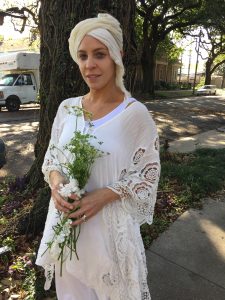
Ophelia said, “It’s time for us to go to the dans. Lorcán will drive us. Rosalie Alley is a home to vodou practitioners. The congregation is known as Guera Anciene. Appropriately, the building they meet in lies between Piety and Desire Streets. Most tourists never find it.”
They walked down the grassy alley toward a bright green building surrounded with a peristyle, passing houses with vodou graffiti, symbols of an ancient African religion and under branches of beautiful, massive oaks. They walked alongside other worshippers, many dressed in white dresses and turbans with red neck scarves. “Who are the people in white?” Cora asked Ophelia.
“Initiates,” she replied. “You might see some of their initiation rituals tonight. The first step is head washing, which deals with the spirits in a person’s head. The second step is kouche, when a person enters a time of seclusion. In that seclusion the initiate symbolically dies before he or she returns to the outside world. Finally, the initiate is given a sacred ason, a beaded rattle with a bell attached, which gives the initiate strength to start healing work and to summon the spirits.”
As they approached the green house, Cora wondered how one becomes an initiate. For the first time in her life, Cora heard the muffled sounds of conga drums and Haitian chants and the tumbao rhythm was surprisingly stirring. When they entered, Cora whispered, “Is this their church?” She looked at the plain wood floor. “There’s no chairs.”
Ophelia said, “No one will be sitting. It’s a simple church, much like the many one will see in Haiti. One difference: The high priestess for this congregation is a white woman. You’ll see there’s no need of chairs, but at least the ceiling fans are working tonight.”
They paused by a candle-lit altar on which lay a human skull, some bones, a bottle of Klérun rum, a machete, a carafe of water, a comb, chalk symbols on a small chalkboard, an icon of the Black Madonna and a few other Catholic icons. Several vodou flags, and banners called drapo, hunt on the walls, each decorated in beaded vévé, symbols and diagrams used to represent the spirits. A man stood by the altar with his eyes closed as if he were in meditation, holding a coned object in his hand
“What’s that man holding?” she asked Ophelia.
“It is a paquet congo, a powerful amulet made of magical ingredients used for healing. Very difficult to make.”
Cora contemplated them and said to Ophelia, “I have much to learn. We can talk later, right?”
“Of course.” Ophelia set a bottle of rum on the altar as her gift, closed her eyes, and whispered, “When I am right, the magic prevails.”
There were three conga players, each with drums of different tuning, and each following his own secret syncopated rhythm designed to create a passageway to the spirit world. I’ve never heard anything like this, Cora thought. The rum-soaked musicians began with slow rhythms and then increased it to invite and honor the Iwa in attendance.
“The ritual dans is beginning. It begins around the poto mitan.” As worshippers began to dance around the center pole, Cora heard prayers and chants offered in the Haitian Kreyòl, and the white priestess drew some symbols in cornmeal on the floor and then poured out some rum. Two worshippers whistled shrill cries on their wooden carved whistles. She heard the devotees call on names she did not recognize—Erzulie Freda, La Sirène, Marassal, and Bondieu. It was at that moment Cora saw the lady she believed must be the high priestess. She was dressed in a long, flowing dress and white scarf on her head with an ason gourd rattle in her left hand. The rattle was decorated with coral and snake bones.
The drummers muted their music as the priestess held up both arms and said, “As we begin tonight, we invoke the blessing of Papa Legba, who stands at the spirit crossroads, open the gates between us; speaker of all human languages, guide and help us as we communicate with the Iwa tonight!”
The three drummers increased both the volume and speed of their rhythms. Cora whispered to Ophelia, “I’ve never heard drumming like this.”
“Ah, the rada music. Drums are sacred to us. There are three different drums there: the largest drum is the manman.”
Cora thought the manman drum to be nearly three feet tall. The player stood and played it with a wooden drumstick in one hand and the other with his bare hand.
Ophelia continued. “The other two drummers who are seated play the segond and the bula.”
Cora felt her pulse rise with rising drum rhythms. More dancers, including Ophelia, joined those circling the poto mitan, twirling, dipping, and bowing. One woman fell to the ground convulsing. Helped to her feet by others, she resumed her dance, but her eyes had rolled upward so that only the whites of her eyes could be seen, as if she had been hypnotized.
Ophelia left the circle of dancers. Cora handed her a bottle of water she plucked from an ice chest by the altar.
“Did you see the woman ridden by the Loa?” Ophelia asked.
Cora assumed she meant the woman who fell down in convulsions. She nodded. “Is she okay?”
“She is fine, and she is honored that the spirit chose her. Tread carefully, Cora. The spirits may choose you.”
The priestess approached them. She took Cora’s hand and smiled. “You are welcome here. This is your first time to attend our worship.”
“Yes,” Cora said, “And thank you. Ophelia brought me.”
Ophelia said, “Mambo Sharon, Cora is my friend, new to New Orleans, She carries some sadness and burdens in her heart. I was sure that you could help her.”
The mambo touched Cora’s cheek and said, “Cora, I hope you will learn from tonight’s service, I will pray that your wounded heart will be healed, and I want you to believe that I am your friend and will come to your help should you ever need me. I’ve a little botánica and art gallery in the French Quarter. Please come and see me. We can drink tea and talk.”
Cora, wondering how the priestess could sense her hurt, felt herself choke and said, “Thank you. I will.”
When the priestess left them to return to the worship, Ophelia put her arm around Cora and gently embraced her. “You’ve found yourself a new friend. Mambo Sharon is one of the most powerful women in New Orleans. There are ten vodou priestesses in New Orleans, and even more in the swamps in surrounding parishes. Mambo Sharon is probably the most powerful.”
Cora said, “Do you think I will need her help?”
Ophelia bit her lip and looked deeply into Cora’s eyes. “Yes, just as I myself needed her help a few years ago. Take off work tomorrow afternoon and go to her botánica and art gallery. It will be such an adventure for you. In her garden she has flowers and plants from Haiti.”
“I don’t want to leave you without help.”
“Don’t worry. You can work till after lunch and then go to her botánica. You won’t regret it. She is a healer of one’s body and heart.”
Cora listened to the prayers and songs of the worshippers in English and French kriol and watched worshippers dance and fall into possession trances, their pupils dilated and their bodies contorting wildly. One shouted, “Papa Legba, open the door Antibon for us to pass now!”
The drummers, their hands swollen and bruised, played on without pause till dawn. When the sound of the drums faded, the worshippers gathered and silently faced the open door, and as the sun rose, a beam of light fell upon the congregation like a kiss.
An Excerpt from Persephone’s Underground by Rickey Pittman

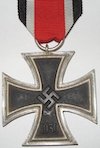 Perhaps the most famous and recognizable medal of World War II is the German Iron Cross. I’ve been a lifelong student of WWII all my life. I remember watching the hundreds of WWII films that were made in the 50s, and perhaps thousands since then, and more than one film has made reference to the Iron Cross. As a teen, I had a German couple who moved next door to my family in Dallas. He had served in the German Army as a photographer on the Eastern Front. He shared with my father and me many of the photographs he had taken. Until that moment, I did not know anything about the Eastern Front in WWII. You can see my published short story I wrote about meeting this German soldier in my blog post, “Like a Good German Soldier.” Sometime in the early 1980s, I once met a veteran in Berwick, Pennsylvania, who showed me a Luger and held an Iron Cross medal he had brought back from his service time in WWII.